By cloudfoodmanager February 10, 2026
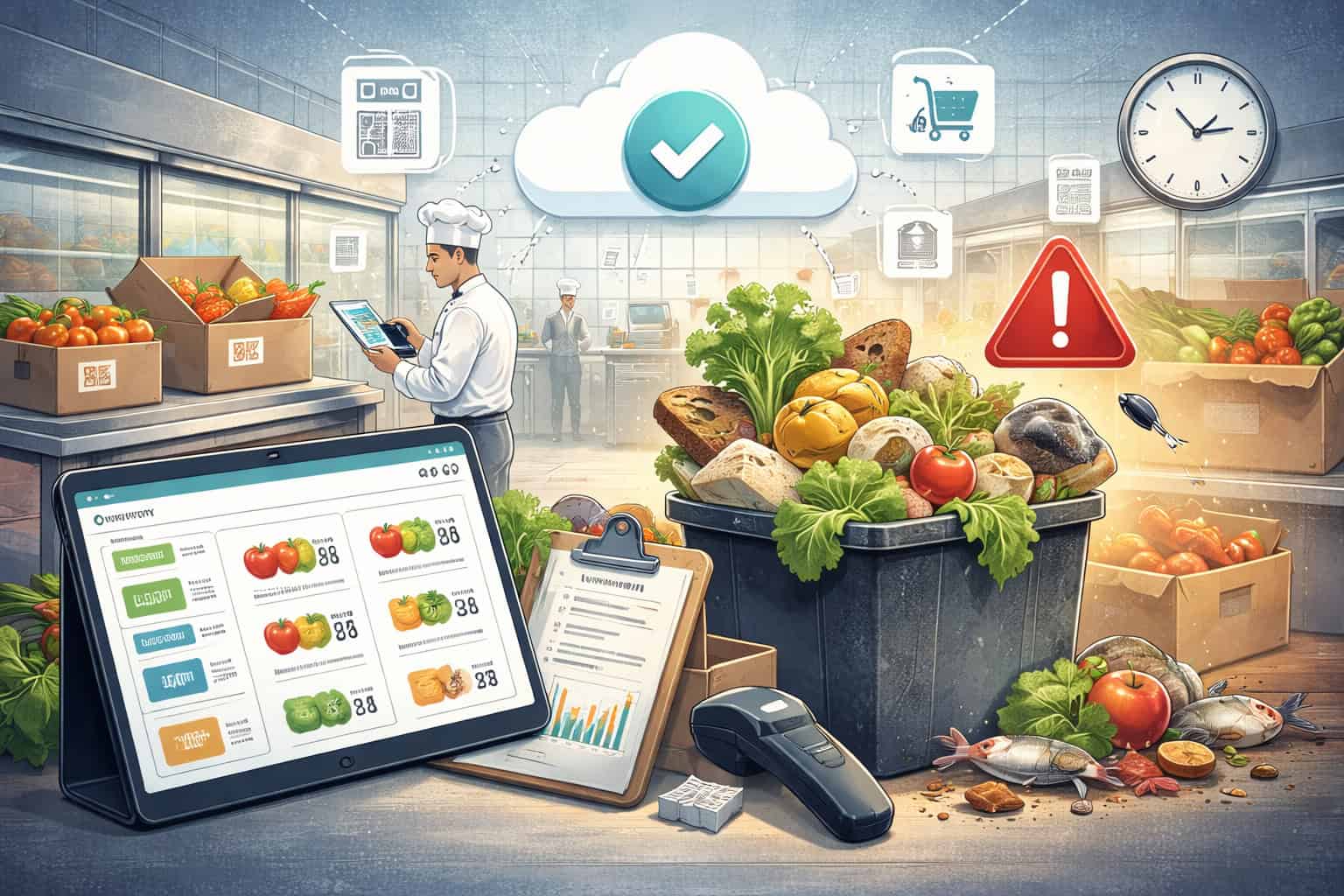
Food waste isn’t just a “too much inventory” problem. In grocery, foodservice, commissaries, meal kits, CPG, and fresh distribution, waste is usually the result of visibility gaps: you don’t know what you have, where it is, what condition it’s in, how old it is, what it will sell as, or what constraints will hit tomorrow.
That’s why real-time cloud inventory tracking has become one of the most practical, high-ROI ways to reduce spoilage, shrink, and markdown losses.
It unifies item-level and lot-level inventory, shelf-life attributes, cold-chain signals, purchasing rules, and demand data into one always-current system—so teams can make decisions based on the truth, not yesterday’s spreadsheet.
From an operator’s perspective, the win is simple: every waste event starts as a small preventable mistake (wrong receiving date, poor rotation, blind purchasing, mis-picks, delayed transfers, missed recall action, overproduction).
Real-time cloud inventory tracking catches those mistakes early and turns them into automated, policy-driven actions—before the product becomes unsellable.
Below are 10 concrete ways real-time cloud inventory tracking eliminates food waste, with industry terminology, real-world examples, compliance tie-ins, and future-focused guidance.
1) It enforces FEFO rotation automatically (and stops “silent expiration”)
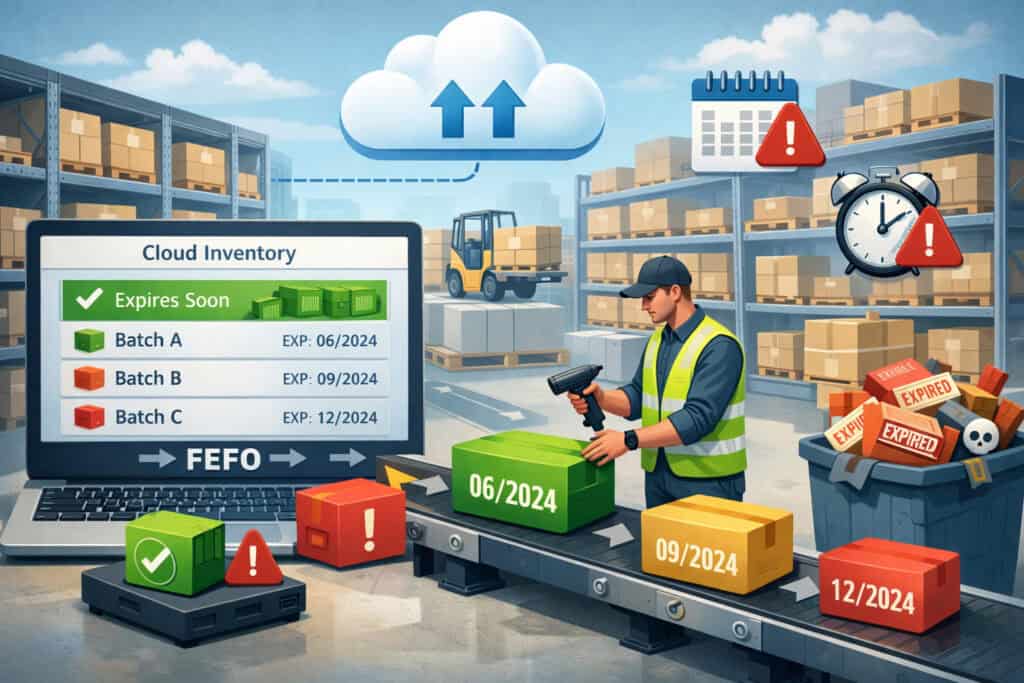
FEFO—First-Expired, First-Out—is the gold standard for perishables. But FEFO fails when teams can’t reliably see expiration dates, pack dates, lot codes, and on-hand by location.
In many operations, receiving captures “cases received” but not shelf-life metadata. That’s how a perfectly good product becomes a waste: it sits in the wrong cooler, it’s forgotten in a back location, or it gets issued after a newer product.
Real-time cloud inventory tracking eliminates this by making shelf-life data part of the inventory record—at receipt, transfer, picking, and production issues. When the system knows each lot’s expiration, it can drive FEFO in three practical ways:
FEFO pick-path control
Pickers are guided to the lot that expires first. If someone scans the wrong case, the system flags it. This prevents the common “grab the closest case” behavior that slowly ages product into shrink.
FEFO replenishment logic
Replenishment can prioritize expiring lots into forward pick locations. In stores and micro-fulfillment, real-time cloud inventory tracking helps ensure the shelf gets the older product first, reducing backroom spoilage.
Expiration-based exceptions
Instead of discovering losses during cycle counts, the system generates exception queues: “7 days to expire,” “14 days to expire,” “short-coded arrivals,” and “ageing inventory.” These are operationally actionable lists—not reports nobody reads.
Business example: A regional grocer receiving fresh dairy across multiple stores often sees waste spike after promotions. With real-time cloud inventory tracking, the DC assigns lot codes at receiving, stores scan at shelf replenishment, and FEFO is enforced in picking. The result is fewer “mystery markdowns” and fewer disposals of yogurt that expired unseen in the back.
The core value is that real-time cloud inventory tracking turns FEFO from a training guideline into a system rule—so waste prevention doesn’t depend on perfect human behavior.
2) It prevents over-ordering with live demand signals and dynamic safety stock

Over-ordering is usually caused by two things: forecast error and inventory inaccuracy. If on-hand numbers are wrong, even a perfect forecast produces waste. If demand shifts and purchasing doesn’t adapt fast, you buy tomorrow’s waste today.
Real-time cloud inventory tracking reduces over-ordering by keeping on-hand accurate and linking inventory to demand patterns continuously. Instead of fixed par levels, you can use dynamic ordering controls:
Dynamic safety stock based on volatility
When demand is volatile (weather swings, holidays, local events), safety stock should change. Real-time cloud inventory tracking supports safety stock policies that adapt to demand variance and lead time, so you avoid “panic buys” that later spoil.
Purchase order guardrails
The system can warn: “You are ordering beyond shelf-life coverage.” That means it calculates days of supply vs. remaining shelf-life, not just how many cases are missing.
Substitution and allocation awareness
When a key ingredient is constrained, teams often overbuy substitutes. With real-time cloud inventory tracking, you can see substitute inventory across locations and allocate intelligently rather than ordering too much everywhere.
Business example: A multi-unit restaurant group often over-orders produce for weekends. By using real-time cloud inventory tracking tied to POS demand, the buyer sees real consumption by menu item, adjusts pars automatically, and prevents Monday-morning compost bins full of leafy greens.
The big idea: real-time cloud inventory tracking makes “order less” safe. You reduce waste without risking stockouts because the system is updating assumptions constantly.
3) It detects temperature excursions early and isolates at-risk lots before they spoil

Cold chain problems create some of the most expensive waste because the product may look fine—until it doesn’t. Temperature excursions during receiving, staging, transit, or cooler failure can shorten shelf life dramatically. Without visibility, teams discover the issue only after spoilage, customer complaints, or failed quality checks.
With real-time cloud inventory tracking, cold chain data can be linked to inventory lots:
Sensor-to-lot linkage
IoT temperature logs (reefers, coolers, pallets) become associated with specific lots. That enables “risk scoring” by lot and location.
Quarantine and hold workflows
If a cooler hits unsafe temperatures for a threshold period, the system can place impacted lots on quality hold automatically—preventing them from being picked or shipped until inspected.
Shelf-life re-calculation
Advanced operators use remaining shelf-life adjustments after excursions. Real-time cloud inventory tracking can reduce expected shelf-life and trigger accelerated sell-through actions (promotions, transfers) before spoilage.
Business example: A fresh seafood distributor experiences occasional dock delays. With real-time cloud inventory tracking plus dock sensors, the system flags lots that stayed above target temperature beyond acceptable limits and routes them to QA.
Waste drops because the team stops shipping products that will fail at the customer, and they can prioritize quick-turn channels for borderline lots.
This is where real-time cloud inventory tracking becomes a quality system—not only an inventory system—cutting waste while protecting brand trust.
4) It eliminates “phantom inventory” and shrink that leads to emergency replenishment (and waste)
“Phantom inventory” is when the system says a product exists, but physically it’s missing. In perishables, phantom inventory causes two waste-heavy behaviors:
- You don’t reorder in time, then rush order too much later.
- You “find” an old product late, and it expires before you can sell it.
Real-time cloud inventory tracking reduces phantom inventory using continuous verification and disciplined scanning:
Perpetual inventory with scan validation
Barcodes, GS1-128, RFID (where feasible), and mobile scans make each movement a recorded event—receiving, putaway, transfer, pick, production issue, waste, donation.
Cycle counting by exception, not calendar
Instead of counting everything monthly, the system targets “high-risk SKUs” and “variance locations,” improving accuracy where it matters most.
Audit trails that pinpoint process breakdowns
Because real-time cloud inventory tracking logs who moved what and when, teams can fix root causes—mis-picks, mis-receipts, unscanned transfers—rather than blaming “shrink” broadly.
Business example: A commissary supplying 40 outlets sees frequent mismatches in proteins. By enforcing scan-to-transfer and scan-to-issue in real-time cloud inventory tracking, they cut emergency replenishment orders (which often overshoot) and reduce waste from late-discovered short-dated inventory.
Accurate on-hand is waste prevention. Real-time cloud inventory tracking makes accuracy a normal output of operations, not a special project.
5) It enables smarter transfers and rebalancing across locations before product expires
In multi-location operations, one site’s surplus is another site’s stockout. But transfers are hard when you don’t trust inventory, don’t know remaining shelf-life, or can’t see demand differences across locations.
Real-time cloud inventory tracking makes transfers a proactive waste-reduction strategy:
Network-wide visibility with shelf-life context
Transfers should move products that will expire from low-demand locations to high-demand locations. Real-time cloud inventory tracking supports this by showing on-hand by lot, expiration, and velocity.
Transfer recommendations and thresholds
The system can recommend transfers when a location’s projected sell-through is lower than remaining shelf-life, and another location’s demand is higher.
Chain-of-custody and cold chain continuity
When a transfer happens, the lot identity remains intact. That’s critical for quality and traceability, especially for regulated or high-risk foods.
Business example: A specialty grocer sees uneven sales across neighborhoods. Real-time cloud inventory tracking flags that one store’s cut fruit will expire in 36 hours while another store has strong demand. A same-day transfer saves that inventory from disposal.
Transfers are often treated as “extra work.” With real-time cloud inventory tracking, they become a targeted, high-impact routine that replaces waste with sales.
6) It reduces production waste with recipe-level visibility, yield tracking, and batch controls
Food manufacturing, central kitchens, bakeries, and prepared foods departments lose inventory through overproduction, bad yields, and batch errors. If you don’t track ingredient lots, yields, and WIP (work-in-process) in real time, you can’t see losses until it’s too late.
Real-time cloud inventory tracking connects production and inventory:
Recipe-based consumption and theoretical vs. actual
The system expects ingredient consumption based on recipes and compares it to actual issues. Variances highlight over-portioning, process loss, or theft.
Yield and trim tracking
For proteins and produce, yield matters. Real-time cloud inventory tracking can track yields by supplier lot, revealing which vendors or specs create waste.
Batch sizing aligned to demand
Production planning improves when you can see demand forecasts and current inventory simultaneously. That prevents “make a little extra” behavior that leads to end-of-day disposal.
Business example: A meal prep company struggles with mid-week waste. With real-time cloud inventory tracking, they connect sales forecasts to batch planning, monitor yields per prep team, and reduce overproduction. Waste drops because batches match demand and ingredient usage is disciplined.
Production waste is often hidden inside “normal operations.” Real-time cloud inventory tracking exposes it with measurable signals.
7) It accelerates markdowns and promotions with time-to-expire pricing actions
Markdowns are not failure—they’re a waste-avoidance tool. The problem is timing: if you discount too late, you still throw product away; too early, you lose margin unnecessarily.
Real-time cloud inventory tracking enables time-based selling strategies:
Automated “sell-first” tasks for near-expiration
Teams get clear action lists: pull forward, bundle, promote, or donate. This avoids the common “we didn’t notice” scenario.
Rules-based markdown timing
For example: discount at 5 days remaining for dairy, 2 days for ready-to-eat items, same-day for bakery. Real-time cloud inventory tracking supports different rules by category and store.
Better assortment decisions
If one SKU consistently requires markdowns, the system evidence supports changing order quantities, packaging formats, or vendor specs.
Business example: A convenience chain uses real-time cloud inventory tracking to trigger markdown labels for short-dated sandwiches by time of day. Sell-through rises, and disposals fall because pricing happens early enough to move product.
Markdowns work best when they’re data-driven. Real-time cloud inventory tracking provides the urgency and precision to turn “almost waste” into revenue.
8) It streamlines donations and diversion programs with compliant tracking
Donation is a strong waste-reduction lever, but many operators struggle with logistics, compliance, and reporting. Without a system, donations are inconsistent, poorly recorded, or missed entirely.
Real-time cloud inventory tracking makes donation operational:
Donation workflows as a standard disposition
When an item approaches expiration, it can be routed to donation instead of trash—based on category rules and local partner pickup schedules.
Traceability and recordkeeping
For certain foods, traceability expectations are rising. The FDA’s Food Traceability Rule (FSMA Section 204) sets requirements for additional traceability records for foods on the Food Traceability List.
Real-time cloud inventory tracking helps keep donation records tied to lots and dates, supporting audits and safer redistribution.
Reporting for sustainability and cost accounting
Donation tracking supports ESG reporting and internal cost visibility, making it easier to justify program investment.
Business example: A big-box retailer donates short-dated produce to local partners. With real-time cloud inventory tracking, donation is a scanned disposition tied to lot and date, simplifying partner coordination and improving accountability.
Donation is easiest when it’s “one click, one scan.” Real-time cloud inventory tracking turns goodwill into a consistent, measurable waste reduction process.
9) It improves recall readiness and reduces “precautionary waste” during safety events
During potential contamination events, many businesses discard far more product than necessary because they can’t identify exactly which lots were affected. That’s precautionary waste—and it can be enormous.
Real-time cloud inventory tracking reduces precautionary waste by enabling precise lot tracing:
Lot-level traceability across receiving, storage, and sale
When every movement is recorded, you can isolate affected lots instead of broad categories.
Standards-aligned identification
GS1 standards (like GTIN, lot/batch identifiers, GS1-128 barcodes) improve the accuracy and speed of traceability across trading partners. Real-time cloud inventory tracking often supports these identifiers to strengthen end-to-end visibility.
Faster response = less disposal
When a recall hits, speed matters. The faster you identify impacted inventory, the less you discard “just to be safe,” and the more you protect customers.
Business example: A distributor receives a supplier alert for a specific lot of packaged salad. With real-time cloud inventory tracking, they identify which customers received that lot and which cases remain in the warehouse, quarantine them, and avoid dumping unaffected products.
Safety events don’t have to create massive waste. Real-time cloud inventory tracking turns recall response into a precise operation rather than a panic.
10) It aligns the entire supply chain with shared, real-time truth (reducing bullwhip waste)
A hidden driver of waste is the bullwhip effect—small changes in consumer demand create larger swings upstream. Suppliers and distributors overproduce, DCs over-order, and stores overstock. Perishables suffer most.
Real-time cloud inventory tracking reduces bullwhip waste by enabling better coordination:
Vendor collaboration and smarter replenishment
When suppliers can receive accurate demand and inventory signals (through EDI, APIs, or portals), they can produce and ship closer to actual need.
Reduced lead-time buffers
Inventory buffers are often inflated to compensate for uncertainty. When real-time cloud inventory tracking reduces uncertainty, buffers can shrink—meaning less product aging in the system.
Better service levels with less waste
The goal isn’t “learn at any cost.” It’s right-sized inventory: enough to meet demand, not so much that you pay to dispose of it.
Business example: A regional produce distributor shares inventory and sell-through signals with growers. With real-time cloud inventory tracking, they smooth ordering patterns, reduce rejected product, and improve freshness for retailers.
This is the strategic layer: real-time cloud inventory tracking reduces waste not only inside one business, but across the network.
How real-time cloud inventory tracking works in practice
To reduce waste reliably, real-time cloud inventory tracking must do three things exceptionally well: capture, contextualize, and act.
Capture means inventory updates happen at the moment of truth—receiving scans, putaway scans, pick scans, production issues, transfers, waste dispositions, and cycle counts. If the system relies on end-of-shift entry, it’s not real-time.
Contextualizing means inventory is not just “SKU + quantity.” For perishables, it needs attributes like lot code, pack date, expiration date, supplier, storage conditions, quality status (released/hold), and location hierarchy (warehouse → zone → bin).
Act means the system produces operational actions: FEFO pick guidance, reorder suggestions, near-expiration tasks, quarantine holds, transfer recommendations, and exception alerts. Waste reduction comes from what teams do differently, not what they see on a dashboard.
This is why real-time cloud inventory tracking is typically integrated with POS, WMS, ERP, procurement, and in some cases IoT temperature monitoring. The goal is one current truth that purchasing, operations, and sales all trust—and that trust is what prevents waste.
Regulations, standards, and governing bodies that influence waste-reduction inventory design
Food inventory systems increasingly overlap with food safety and traceability expectations. If you’re designing real-time cloud inventory tracking for long-term resilience, build with compliance in mind:
FDA Food Traceability Rule (FSMA Section 204)
The FDA’s Food Traceability Rule establishes additional traceability recordkeeping requirements for certain foods on the Food Traceability List, referenced in 21 CFR Part 1 Subpart S.
The FDA has addressed compliance timing, including a proposed delay and direction not to enforce prior to a later date noted on FDA’s rule page. Even if your business is not fully in scope, aligning real-time cloud inventory tracking with lot-level recordkeeping and event capture is increasingly a best practice.
GS1 identification standards
GS1 standards help trading partners share product identity (GTIN), logistics identity (SSCC), and batch/lot details in scannable formats like GS1-128, improving traceability and inventory accuracy.
Food loss and waste reduction goals
National initiatives to reduce food loss and waste emphasize measurement and action. USDA and EPA have highlighted a goal to cut food loss and waste by half by 2030.
Real-time cloud inventory tracking supports the measurement backbone needed to show progress credibly.
A practical takeaway: design real-time cloud inventory tracking so that identity, movements, and dispositions are easy to capture—because both waste reduction and safety readiness depend on those fundamentals.
Implementation guide: rolling out real-time cloud inventory tracking without disrupting operations
A common failure mode is trying to “digitize everything” at once. Waste reduction happens faster when you implement real-time cloud inventory tracking in phases that match operational reality:
Phase 1: Fix inventory accuracy at receiving and core movements
Start with receiving scans (including lot/expiry capture), putaway, transfers, and picking. Accuracy drives everything else.
Phase 2: Add perishables logic (FEFO + expiry workflows)
Enable FEFO picking, near-expiration alerts, and disposition workflows (markdown, donation, waste). This is where waste reduction accelerates.
Phase 3: Integrate demand and purchasing
Connect POS and forecasting inputs. Implement dynamic par levels and shelf-life coverage checks.
Phase 4: Add cold chain and quality signals
Link temperature monitoring and hold/release workflows for high-risk categories.
Phase 5: Optimize with KPIs and continuous improvement
Use dashboards for shrink by category, expiry waste by supplier, cycle count variance, and sell-through.
Throughout all phases, train teams on why scans matter. Real-time cloud inventory tracking only becomes “real-time” when it becomes the default workflow—not a parallel admin task.
KPIs to prove waste reduction (and keep it from creeping back)
To demonstrate strong E-E-A-T outcomes, track metrics that operators and finance both respect. Real-time cloud inventory tracking enables consistent KPI measurement:
Waste rate by category and reason code
Separate spoilage, damage, temperature, overproduction, and recall-related disposition.
Expiry exposure (value within X days of expiration)
This is a leading indicator. If expiry exposure rises, waste will follow.
Inventory accuracy and variance
Cycle count variance trends reveal whether process compliance is improving.
Markdown efficiency
Measure markdown dollars vs. disposal dollars. Better markdown timing should reduce disposal.
Transfer save rate
Track value transferred that would have expired at the origin location.
These KPIs keep real-time cloud inventory tracking from becoming “just another system.” They connect actions to profit and sustainability.
Future predictions: where real-time cloud inventory tracking is headed next
The next wave of real-time cloud inventory tracking will be more autonomous, more sensor-driven, and more interoperable across partners:
Predictive shelf-life and quality scoring
Systems will increasingly combine temperature history, supplier performance, and product class to predict remaining shelf-life more accurately than static dates.
Computer vision for backroom and shelf visibility
Cameras will supplement scans, reducing manual effort and catching missed rotations.
Wider adoption of interoperable traceability data
As trading partners align on standards and regulatory expectations, inventory data will move more smoothly across the chain—reducing precautionary waste and enabling faster action during safety events.
Automated waste-prevention orchestration
Instead of alerts, systems will trigger workflows: auto-create transfer orders, suggest markdown price points, route donations based on pickup schedules, and quarantine lots automatically after temperature excursions.
The theme is clear: real-time cloud inventory tracking is becoming the control tower for perishables—integrating demand, quality, and compliance into one operational brain.
FAQs
Q.1: What’s the difference between real-time cloud inventory tracking and a traditional inventory system?
Traditional systems often update inventory in batches—end of day, end of shift, or after manual reconciliation. Real-time cloud inventory tracking updates inventory at the moment of each operational event: receiving, putaway, pick, transfer, production issue, and disposition. For perishables, that time difference is everything.
If you discover expiry risk a week late, you can’t transfer or promote product in time. Real-time cloud inventory tracking also stores perishables attributes (lot, expiry, quality status) and turns them into actions like FEFO picks and near-expiration tasks. That combination—timeliness plus shelf-life context—drives waste reduction.
Q.2: Do I need item-level tracking to reduce food waste, or is lot-level enough?
Answer: For most perishables programs, lot-level tracking is the strongest ROI: it enables FEFO, recall precision, shelf-life coverage checks, and targeted markdowns. Item-level tracking (or case-level with serialized identifiers) can add value in high-risk categories, high-value proteins, or where shrink is severe.
The practical approach is to start with real-time cloud inventory tracking at lot level and strengthen capture quality (accurate lot/expiry entry, disciplined scanning). Once that foundation is solid, you can evaluate RFID, serialization, or computer vision where it’s economically justified.
Q.3: How does real-time cloud inventory tracking help with traceability requirements?
Answer: Traceability requires consistent capture of key data (like lot codes) and the ability to produce records quickly. The FDA’s Food Traceability Rule (21 CFR Part 1 Subpart S) focuses on additional traceability records for certain foods and expects firms to maintain and provide records tied to critical events.
Real-time cloud inventory tracking supports this by linking lot identity to receiving, transformations, and shipments—so you can isolate impacted lots during an investigation or recall and reduce precautionary waste.
Q.4: What’s the fastest way to get waste reduction wins after implementing?
Answer: The fastest wins usually come from three moves inside real-time cloud inventory tracking: (1) enforce FEFO picks, (2) set near-expiration action queues (transfer/markdown/donation), and (3) implement shelf-life coverage checks for purchasing.
These changes directly prevent “silent expiration” and over-ordering. Many operators see measurable reductions in disposal within the first few cycles once those workflows are consistent, because you’re acting on risk earlier instead of discovering waste at the end.
Q.5: Can small businesses use real-time cloud inventory tracking effectively?
Answer: Yes—especially because cloud tools reduce infrastructure overhead. The key is to keep the workflow lightweight: mobile receiving scans, simple lot/expiry capture, and a small set of exception lists (near-expiration, negative inventory, variance counts).
Small operators often benefit more because they feel the pain of every disposal dollar. With real-time cloud inventory tracking, small teams can run disciplined rotation and purchasing without needing a full analytics department.
Q.6: How do I keep scan compliance high without slowing teams down?
Answer: Scan compliance rises when scans replace paperwork rather than adding to it. Use mobile-friendly screens, minimal required fields (but never skip lot/expiry for perishables), and design workflows that save time—like automatic FEFO location guidance and quick disposition buttons.
Also, measure process KPIs: if real-time cloud inventory tracking shows recurring variances in a location or shift, fix the workflow, not just the behavior. When teams see that scans prevent rework and emergencies, compliance becomes self-reinforcing.
Conclusion
Food waste is rarely a single catastrophic mistake. It’s a chain of small visibility failures—uncertain on-hand, missed FEFO, blind purchasing, delayed markdowns, unmanaged cold chain risk, and unclear dispositions.
Real-time cloud inventory tracking breaks that chain by keeping inventory truthful, shelf-life-aware, and operationally actionable across every location and team.
When implemented well, real-time cloud inventory tracking doesn’t just report waste after it happens. It prevents waste by turning shelf-life and demand signals into decisions: order the right amount, rotate the right lot, transfer before expiry, quarantine when quality is at risk, and donate instead of disposing.
It also future-proofs operations by aligning with traceability expectations and standards-based identification practices.