By cloudfoodmanager February 10, 2026
Scaling a food business is less about “opening another location” and more about repeating a great experience—at speed—without losing margin, quality, or control.
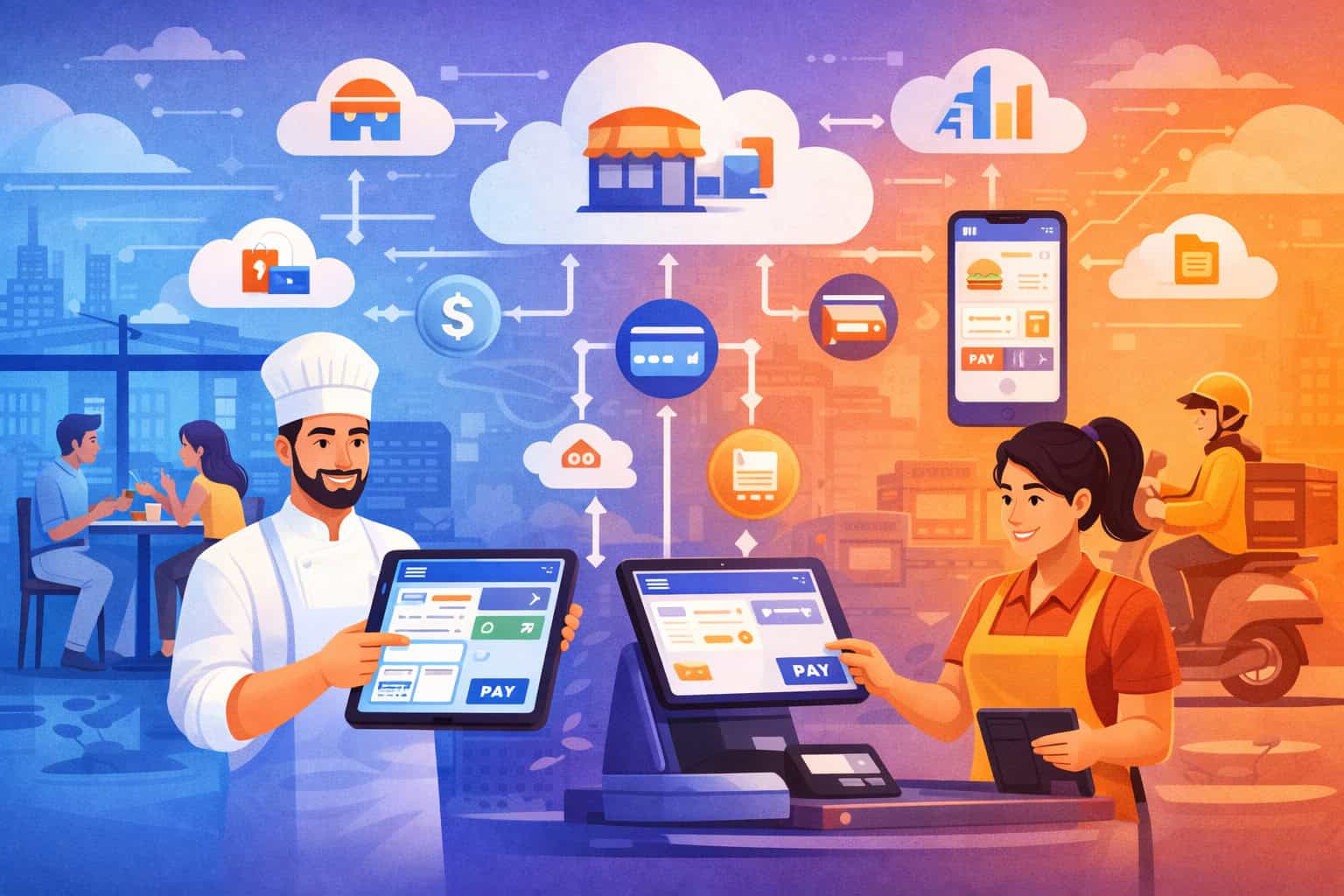
The moment you add new channels (online ordering, delivery marketplaces, catering), new service models (counter service, kiosk, QR ordering), or new sites (second kitchen, pop-up, franchise), the complexity curve spikes. That’s where cloud POS systems become the operational backbone instead of “just a register.”
A modern food operation runs on data: item-level sales, modifiers, prep times, labor percentages, inventory variance, refunds, comps, and chargebacks. With cloud POS systems, those signals flow into one system in near real time, so leadership can make decisions quickly and store teams can execute consistently.
The alternative—legacy on-premise systems, disconnected tablets, manual spreadsheets, and “we’ll reconcile later”—creates blind spots that are manageable at one store, and painful at five.
From an operator’s perspective, the best reason to adopt cloud POS systems is simple: they help you standardize what must be consistent while letting each location keep what must stay local. When you’re growing, consistency protects your brand, and flexibility protects your revenue.
Below is a detailed, practical guide to how cloud POS systems support scaling—operations, security, compliance, customer experience, and future readiness—using the language and realities of food operators.
What a Cloud POS System Really Is (and Why It’s Built for Growth)
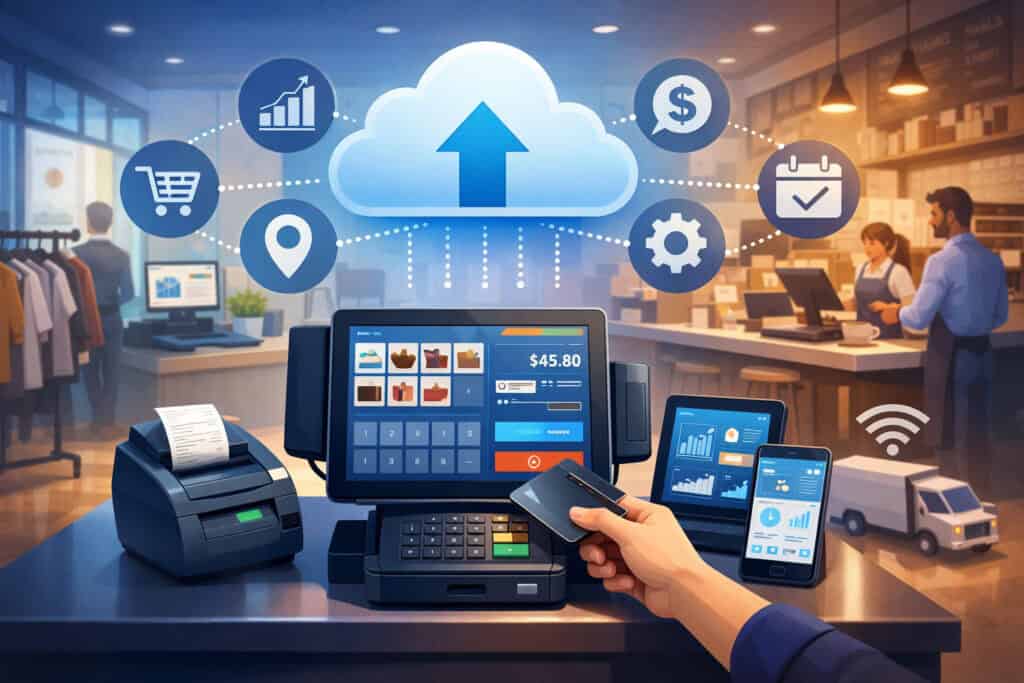
A cloud POS is a point-of-sale platform where the “source of truth” lives in secure cloud infrastructure rather than a single back-office computer.
In practice, cloud POS systems combine front-of-house order entry, payment acceptance, and receipt management with centralized back-end tools like menu management, reporting, user permissions, integrations, and device monitoring.
For scaling food businesses, what matters is not the buzzword “cloud.” It’s the architecture. Because data is stored centrally, cloud POS systems let owners and operators access reporting dashboards from anywhere, push menu updates to multiple locations at once, and standardize workflows across stores.
When you add a second location, you don’t want to rebuild everything: you want to copy a proven configuration, adjust a few local settings, and go live with minimal friction.
Cloud systems also reduce dependency on “the one person who knows the back office computer.” In many small food brands, operational knowledge becomes tribal: one manager understands pricing, another knows inventory, and the owner knows how to pull reports.
Cloud POS systems turn that into a process: roles, permissions, templates, audit trails, and consistent exports to accounting.
Most importantly, cloud architecture is the foundation for modern channels—online ordering, loyalty, delivery integration, kitchen display systems (KDS), and QR ordering—because these channels rely on always-synced menus, pricing, and order routing.
If your menu changes weekly, or your modifiers are complex, cloud POS systems dramatically reduce menu chaos as you expand.
Cloud POS vs. Legacy POS: The Scaling Difference in Plain Terms
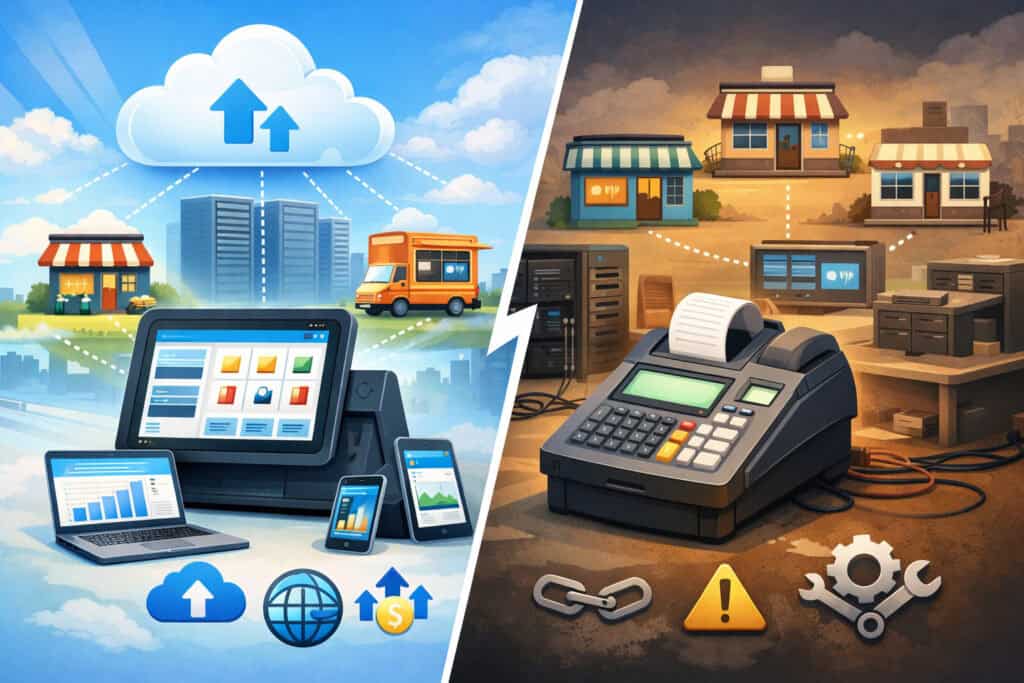
Legacy on-premise POS is often stable in a single-store context, but it tends to break down when you scale. You may end up exporting reports from each location, emailing spreadsheets, and manually normalizing categories (“Burgers” vs “Burger”). You may also face hardware lock-in and slower integration options.
In contrast, cloud POS systems are designed around centralized configuration and distributed execution. That means you can roll out standardized menus and recipes, keep consistent item naming for reporting, and manage permissions across locations from a single admin console.
When you add a new location, you can clone your setup: taxes, service charges, tip rules, receipt templates, and kitchen routing.
From a growth standpoint, cloud also improves speed of iteration. If a promo underperforms, you can adjust pricing rules quickly. If a modifier is confusing, you can update it across stores without waiting for a technician. If your catering flow is causing errors, you can re-map it once and deploy everywhere.
The result is a system that grows with you rather than requiring periodic “rip-and-replace” migrations. If your plan includes multiple sites, multiple revenue channels, or franchise-style consistency, cloud POS systems move from “nice to have” to essential.
Core Building Blocks: What to Look for in a Real Cloud POS
Not all “cloud” products are equally cloud-native. For scaling, the capabilities that matter tend to cluster into a few building blocks.
First is centralized menu governance: menu groups, modifier sets, pricing tiers, time-based menus, and location-level overrides. Second is robust reporting: item-level performance, labor vs sales, refunds/comps, payment mix, and channel breakdown.
Third is reliable payments: EMV chip acceptance and tokenization for card data, with strong compliance tooling and hardware support. EMV standards are maintained by EMVCo and underpin chip-based payment interoperability.
Then you need integrations: accounting exports, payroll, inventory tools, delivery platforms, loyalty, gift cards, and online ordering. This is where APIs (application programming interfaces) matter: scaling brands rarely run on one system. Cloud POS systems should connect cleanly so you don’t create “integration debt” that slows you down later.
Finally, you want control: role-based access, device health monitoring, audit logs, and multi-location administration. When a brand grows, mistakes multiply unless the system makes the right behavior easy and the wrong behavior hard. That’s a key reason cloud POS systems are foundational for sustainable scaling.
Multi-Location Growth: Centralized Control Without Killing Local Agility
Opening a second location is the first time many food owners realize they’re no longer running a restaurant—they’re running a brand.
The question becomes: how do you keep the same burger tasting the same, the same modifiers available, the same refund rules, and the same guest experience, even when the staff is new and the manager has their own habits?
This is where cloud POS systems are essential. They provide centralized control over the elements that must remain consistent—menu architecture, pricing logic, taxes, service charges, payment methods, and reporting categories—while allowing limited, intentional flexibility for local conditions.
For example, you can maintain a master menu but allow location-level availability (sold-out controls, seasonal add-ons, local specials) without breaking corporate reporting.
A scaling operator also needs speed. If a new location is underperforming at lunch, you need day-part reporting quickly. If a store is discounting too often, you need comp and discount audit trails. Cloud POS systems make these insights accessible without manual reporting gymnastics.
And beyond analytics, centralized management reduces the cost of training. When every store uses the same button layout, modifier flow, and kitchen routing, staff transfers are smoother and onboarding is faster. That directly affects consistency, which directly affects repeat business.
Menu, Pricing, and Tax Governance Across Locations
As soon as you scale, menu management becomes a system problem. Pricing tiers, time-based menus, and channel-specific menus can get out of hand quickly. Cloud POS systems allow you to manage these complexities using structured tools rather than ad hoc edits.
Consider a fast-casual brand with dine-in, takeout, and online ordering. You may want different pricing by channel, or at least different upsell logic. You may want delivery menus to exclude items that travel poorly.
You may also need location-level tax configurations that vary by jurisdiction. A strong cloud platform lets you keep a standardized item catalog while applying targeted rules.
This is also where food safety labeling and ingredient transparency can become relevant. Many local health departments base their retail food rules on the FDA Food Code, which is updated periodically and used as a model for safeguarding public health in food service.
A cloud system can support consistent item naming, allergen notes, and recipe references across locations, improving operational discipline.
When brands don’t standardize menu governance early, they often pay later with messy reporting and inconsistent guest experiences. Cloud POS systems help you treat the menu like a controlled asset, not a set of disconnected buttons.
Multi-Store Reporting That Actually Drives Decisions
Scaling isn’t just “more sales.” It’s more variables: different managers, different shifts, different local demand patterns. Without unified reporting, operators end up reacting emotionally (“Store B feels slow”) rather than operationally (“Store B’s lunch ticket time is 18% longer and modifier errors are 2x”).
Cloud POS systems provide normalized reporting so leadership can compare stores apples-to-apples: category performance, top items, void and refund rates, average ticket size, labor percentage, and channel mix. They also make it possible to set baselines and track variance.
A real-world example: a five-location concept sees rising food cost but stable sales. With unified cloud reporting, the operator can isolate that one store has higher voids and discounts during dinner.
That points to either training gaps, theft risk, or a kitchen bottleneck. Without cloud-level visibility, it might take months to find.
The other scaling advantage is speed of close. Cloud-based end-of-day reporting, automated exports, and consistent category mapping reduce the time it takes to close books.
The faster you close, the faster you learn, and the faster you can correct the course. That learning loop is one of the biggest competitive advantages that cloud POS systems provide as you grow.
Operational Efficiency: Faster Service, Fewer Errors, Higher Throughput
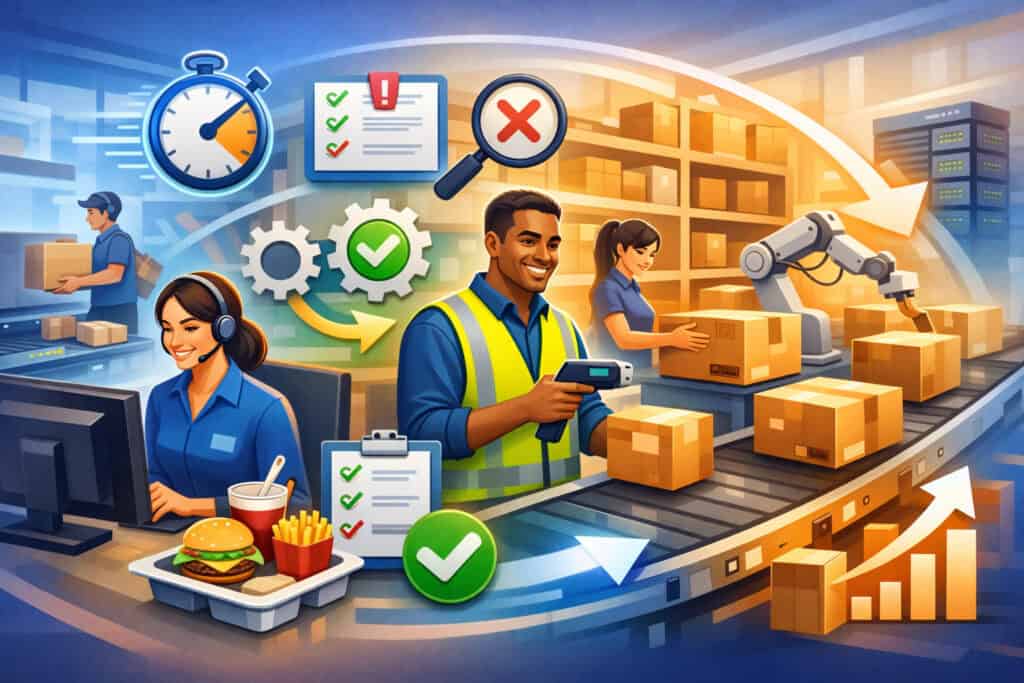
In food service, revenue isn’t only about demand—it’s about throughput. If you can’t produce and deliver orders accurately during peak hours, you leave money on the table and damage your reviews.
As you scale, small inefficiencies become expensive: a 30-second slowdown per order can mean dozens of lost tickets during rush.
Cloud POS systems improve efficiency in three main ways: streamlined order entry, cleaner kitchen communication, and better visibility into bottlenecks.
When configured correctly, the POS becomes a “guided workflow,” reducing the cognitive load on cashiers and servers. Modifiers become structured. Upsells become consistent. Voids and comps require manager approval. Kitchens get clear tickets that reduce misfires.
Operational efficiency is also about standardization. A growing brand should aim for consistent station setup, consistent ticket formatting, and consistent order routing. Cloud-based configuration makes it easier to deploy these standards across stores without relying on local improvisation.
Finally, cloud platforms support service model changes without starting over. If you add curbside pickup, QR ordering, or kiosks, a cloud-based back end can update menus, assign prep routes, and consolidate reporting by channel.
That flexibility matters because scaling often involves experimentation—and cloud POS systems reduce the cost of experiments.
Kitchen Display Systems, Order Routing, and Prep-Time Discipline
A major step up from paper tickets is a kitchen display system (KDS). When paired with cloud POS systems, a KDS can route orders to the right stations (grill, fry, expo, bar), mark items as fired, and track ticket times in real time.
For example, a casual dining operation may route appetizers to one station and entrees to another, but fire timing depends on table status.
A cloud POS + KDS setup can support coursing logic and reduce mistakes like sending desserts too early. In fast-casual, KDS improves accuracy by showing modifiers clearly and reducing lost tickets.
The hidden scaling value is measurement. If you can track ticket time by station and by channel (in-store vs delivery), you can decide whether to add a prep cook, split a station, or simplify the menu. Operators often guess; data makes it clear.
A practical example: a ghost kitchen sees high refund rates from delivery orders. With KDS time stamps and order routing analytics, the operator identifies that delivery orders are being deprioritized during in-store rush, causing cold food and complaints.
The fix might be dedicated “delivery batching” during peaks—something that’s hard to implement consistently without cloud POS systems and standardized routing rules.
Uptime, Offline Mode, and Business Continuity During Outages
Operators worry—rightfully—about internet outages. The best cloud POS systems address this with offline capabilities: local order-taking continues, payments may continue in limited modes depending on configuration, and data syncs when connectivity returns.
This matters more when you scale. A single outage at one store is a headache. Recurring instability across multiple stores becomes a systemic risk. Cloud platforms often provide device monitoring, automated alerts, and centralized troubleshooting tools, reducing downtime and support burden.
Business continuity is also about device sprawl. As you add tablets, handhelds, kiosks, and kitchen screens, you need a system that can manage updates and reduce “random breakage.”
A strong cloud vendor provides consistent device management guidance, reliable hardware compatibility, and clear fallback processes.
The operational point is this: scaling requires predictable service. Predictable service requires resilient systems. Cloud POS systems—with tested offline workflows and centralized monitoring—reduce the chance that a technology hiccup turns into a lost Saturday night.
Inventory and Food Cost Control: Turning Sales Data Into Margin
Food businesses don’t fail because they can’t sell. They fail because they can’t keep margin while they sell. As you expand, the gap between “ideal food cost” and “actual food cost” often widens due to purchasing inconsistency, portion drift, waste, theft, or recipe creep.
Cloud POS systems help close that gap by connecting what you sell to what you should consume. When items, modifiers, and recipes are structured correctly, sales data becomes an input for inventory depletion.
Even if you’re not using a full ingredient-level system on day one, cloud POS reporting can still show early warning signs: unusual item mix shifts, increased voids, heavy discounting, or abnormal refunds.
The scaling advantage is control across locations. You can standardize item naming, map recipes consistently, and compare variance store-to-store. If Store A runs 3% higher food cost than Store B with similar sales, you have a targeted problem to solve rather than a vague worry.
Inventory discipline also supports better purchasing. With consistent sales trends and par levels, you can reduce stockouts and over-ordering. That’s not just a cost issue—it’s a brand issue.
Running out of a signature item on weekends damages trust and can ripple into negative reviews. Cloud POS systems make it easier to see problems early and fix them systematically.
Ingredient-Level Tracking, Recipe Mapping, and Real-World Wins
At scale, ingredient-level tracking becomes a competitive advantage. When every sale updates expected ingredient depletion, managers can reconcile inventory with more precision and spot anomalies faster.
Consider a pizza concept expanding from one to three stores. Cheese and protein costs swing weekly, and portioning varies by staff.
By using cloud POS systems with recipe mapping (even if supported through an integrated inventory tool), the operator can set standard portions and monitor variance. If one store’s “extra cheese” modifier spikes, it may indicate staff defaulting to heavy portions or a misconfigured modifier button.
Real-world impact shows up in small numbers that add up. A 1% improvement in food cost across multiple locations can mean thousands in monthly profit. Cloud-based reporting helps you prioritize where to focus: which categories are leaking margin, which modifiers drive waste, and which shifts show the most variance.
This also supports menu engineering. If a high-selling item has low margin due to ingredient inflation, you can adjust price, reduce portion slightly, or redesign the recipe—then push updates across stores consistently.
That is one of the strongest reasons cloud POS systems are essential for growth: they turn menu decisions into controlled, measurable actions.
Waste, Variance, and Smarter Purchasing as You Scale
Waste is often invisible until it’s expensive. In a single store, an owner might “feel” waste levels. In a multi-unit business, feelings aren’t enough. You need structured waste logging, variance reporting, and consistent purchasing workflows.
Cloud POS systems contribute by providing accurate sales counts by item and modifier, which can be compared to inventory usage.
Even before full inventory integration, you can use POS mix reports to estimate expected usage. If wings sales are steady but purchasing spikes, something is off—portioning, spoilage, theft, or inaccurate receiving.
Scaling also increases the complexity of purchasing and receiving. Different managers order differently. Vendor substitutions happen. Receiving is rushed. Cloud-connected tools, combined with standardized POS categories and recipes, make it easier to create consistent par levels and order guides.
A useful approach is to treat each location like a controlled experiment. With cloud POS systems, you can track whether a new supplier reduces waste, whether a revised prep method improves yield, or whether a price change affects mix.
This is how growing food brands protect margin while expanding volume: systematize measurement, then iterate intentionally.
Customer Experience and Revenue Growth: Meeting Guests Where They Buy
Guest expectations have changed. People want fast ordering, accurate customization, multiple payment methods, digital receipts, loyalty rewards, and frictionless pickup. Scaling brands can’t rely on staff heroics to deliver that experience consistently—especially when hiring is tight and turnover is real.
Cloud POS systems enable revenue growth by supporting modern channels while keeping the experience unified. That means your menu, pricing, and availability are consistent across counter, online ordering, and third-party delivery. It also means data from all channels rolls up into one view so you can understand what’s actually driving sales.
As you grow, customer experience becomes your marketing engine. Great experiences create repeat visits, higher ratings, and stronger word-of-mouth. Bad experiences scale too. A cloud platform reduces common failure points: wrong modifiers, missing items, confusing pickup instructions, and inconsistent pricing between channels.
Cloud-based systems also support personalization through loyalty and customer profiles. Even simple loyalty programs can lift repeat purchases, particularly in QSR and fast-casual.
The key is operational execution: rewards must be redeemed cleanly, offers must be measurable, and staff must not dread using the system. Cloud POS systems are built to make these programs operationally feasible.
Online Ordering, QR, Kiosks, and Delivery Integrations That Don’t Break Ops
Many growing food businesses add digital ordering because it increases convenience and captures demand outside dining room constraints. But the real risk is fragmentation: one menu for in-store, one for the website, one for delivery apps, and none of them match.
Cloud POS systems reduce fragmentation by acting as the menu and order-routing hub. When an online order comes in, it should print or display in the kitchen exactly like an in-store order, with the same modifiers and timing logic. That consistency is what keeps quality stable when volume spikes.
QR ordering and kiosks introduce another layer: accessibility and usability. Technologies used by the public should be designed with accessibility obligations in mind under disability access expectations.
Resources on ADA.gov increasingly address how accessibility applies to certain technologies, including point-of-sale devices, and the broader ecosystem includes guidelines and discussions for self-service transaction machines. A scaling brand should treat kiosk/QR UX as part of brand quality, not an afterthought.
Operationally, the goal is to prevent “channel chaos.” If delivery orders overwhelm the kitchen, you may need throttling, item-level availability controls, or channel-specific prep rules. Cloud POS systems can support these controls so the kitchen stays sane while revenue grows.
Loyalty, Gift Cards, and Personalization Without Losing Brand Consistency
Loyalty isn’t just points—it’s a structured reason to return. For scaling businesses, loyalty programs and gift cards can become predictable revenue levers, especially when tied to targeted offers (weekday lunch boosts, new item trials, birthday rewards).
Cloud POS systems support loyalty by maintaining customer profiles, tracking purchase history, and applying promotions consistently across locations. This matters because loyalty breaks down if redemption works in Store A but not Store B, or if staff doesn’t know how to apply rewards quickly.
Gift cards are another scaling tool. They drive upfront cash flow and introduce your brand to new guests. But gift cards also introduce liability tracking and reconciliation complexity. A cloud-based system helps centralize gift card balances, unify redemption across stores, and simplify reporting.
Personalization should still protect brand identity. A smart approach is to standardize what you measure (items, categories, frequency) while allowing local marketing to adjust offers based on neighborhood demand. Cloud POS systems provide the common foundation so your marketing becomes measurable and repeatable rather than random.
Labor, Scheduling, and Compliance: Scaling Without Payroll Chaos
Labor is the largest controllable cost in most food businesses, and it’s also the most sensitive. Scaling multiplies scheduling complexity, increases compliance exposure, and makes tip handling more complicated—especially across roles, shifts, and multiple locations.
Cloud POS systems help by tying labor data to sales in real time. Managers can see whether the schedule aligns with demand patterns and adjust before labor percentage blows up. Over time, you can build templates: staffing levels by daypart, by season, and by location type.
Compliance matters more as you grow. Tips, service charges, overtime rules, minor labor rules, and wage statements become higher-risk when your headcount grows. Cloud-based systems can enforce role permissions, require manager approvals, and maintain audit logs that reduce “he said, she said” disputes.
Even if your POS doesn’t handle payroll directly, it should export clean data: hours, tips, tip-outs, and role codes. That prevents reconciliation nightmares.
Operators who wait too long to standardize labor workflows often end up with inconsistent tip rules and payroll surprises. Cloud POS systems help you standardize early so scaling doesn’t turn into a compliance and payroll fire drill.
Tip Management, Reporting Expectations, and Operational Best Practices
Tipping is operationally complex: cash tips, charged tips, tip pools, tip sharing, and service charges often get mixed together incorrectly. Scaling brands should separate these clearly in workflows and reporting.
For larger food or beverage establishments that meet certain thresholds, tip reporting obligations can include annual reporting to tax authorities using specific forms.
The IRS provides guidance on Form 8027 for employer reporting of tip income and allocated tips, including updates and electronic filing specifications. This isn’t just paperwork—incorrect handling can lead to employee disputes and compliance risk.
Cloud POS systems support better tip discipline by tracking charged tips precisely, tying tips to employees/shifts, supporting tip-out rules, and creating audit trails.
They also help standardize the difference between tips and service charges, which is important because service charges are typically treated differently than voluntary tips in wage and tax contexts.
A real-world example: a multi-unit concept uses inconsistent tip-out logic between stores. Staff transfers become contentious, and managers manually adjust tips at close. With cloud POS systems, the operator can implement standardized rules—role-based tip-outs, clear reporting, and manager approval controls—reducing friction and improving trust.
Role-Based Access, Audit Trails, and Reducing Internal Shrink
Shrink in food operations is not only inventory. It’s also unauthorized discounts, refunds, void abuse, and cash drawer variance. As you scale, you cannot personally oversee every close. You need systems that create accountability.
Cloud POS systems enable role-based access controls: cashiers can ring sales, but only managers can void past orders or issue refunds. Discount permissions can be restricted. No-sale drawer opens can be tracked. These controls are operational safeguards that protect margin and reduce internal risk.
Audit trails become critical when you’re managing remotely. If Store C’s refund rate spikes, you need to know who issued refunds, when, and why. A cloud system can make that visible quickly. This is not about policing people; it’s about running a repeatable business where exceptions are documented and rare.
As you grow, you’ll also see the value of standardized close procedures: cash counts, deposit logs, and end-of-day reporting. When cloud POS systems standardize close workflows, you reduce variation and uncover problems earlier—before they become habitual or expensive.
Payments, Security, and Data Privacy: Protecting Trust at Scale
Payments are where your food business touches regulated financial infrastructure. When you scale, payment risk scales too: more terminals, more employees, more card volume, more chargebacks, and more exposure if something goes wrong.
Cloud POS systems are often built with modern payment security practices like tokenization, encrypted card readers, and secure key management, reducing the scope of sensitive card data your business handles directly. This matters for compliance and for practical risk reduction.
Industry security expectations for handling cardholder data are shaped by the Payment Card Industry Data Security Standard (PCI DSS), maintained by the PCI Security Standards Council.
PCI DSS v4.0 was published to provide a baseline of technical and operational requirements designed to protect account data. Additionally, PCI DSS v4.0 includes future-dated requirements that became mandatory on March 31, 2025, making it even more important for merchants and service providers to align systems and practices accordingly.
Privacy is also part of trust. Even small food brands collect personal data through online ordering, loyalty, Wi-Fi marketing, and delivery. Scaling brands should plan for privacy obligations and consumer expectations from day one, because retrofitting privacy controls later is painful.
PCI DSS, EMV, Tokenization, and What “Secure Payments” Really Means
The strongest payment posture combines secure hardware, compliant processes, and clear accountability. EMV chip acceptance is a baseline expectation for in-person payments, with specifications maintained by EMVCo to support secure, interoperable chip-based transactions.
For a scaling food business, EMV reduces counterfeit fraud risk and helps align your acceptance practices with industry norms.
PCI DSS is broader: it covers how organizations protect card data across systems and processes. PCI DSS v4.0’s evolution and its future-dated requirements timeline highlight that compliance is not “set it and forget it.”
This is one reason cloud POS systems are valuable: reputable platforms typically invest continuously in security, certifications, and secure payment architectures so merchants don’t have to invent their own controls.
Tokenization is another key term: instead of storing actual card numbers, systems store tokens that are useless if stolen. Combined with encryption in transit and at rest, this reduces breach impact.
Your operational goal is to minimize the “cardholder data environment” you control directly and rely on secure, validated payment flows.
When scaling, also think about chargebacks and fraud operations. Centralized reporting, consistent refund policies, and clean receipts help prevent disputes and respond faster when they happen—another practical benefit of cloud POS systems.
Privacy, Cybersecurity Standards, and Handling Customer Data Responsibly
Scaling brands often collect more data than they realize: names, emails, phone numbers, order history, and sometimes location or preferences. That data can be valuable for marketing, but it also creates responsibility.
Privacy rules can vary by state and business model. For example, California’s privacy framework (including CPRA amendments) expanded consumer rights beginning January 1, 2023, including rights related to correcting information and limiting use of sensitive personal information.
Even if you don’t operate in California today, scaling brands benefit from adopting “privacy by design” practices early: clear consent for marketing, data minimization, and retention policies.
From a cybersecurity standpoint, many organizations use NIST’s Cybersecurity Framework as a risk-reduction guide, and NIST released Cybersecurity Framework 2.0 in February 2024 to broaden applicability and update guidance.
You don’t need to become a cybersecurity expert to benefit: the framework reinforces basics like identifying assets, protecting systems, detecting incidents, responding effectively, and recovering quickly.
Cloud POS systems can support these outcomes via strong access controls, device monitoring, and vendor-managed security updates. For a growing food business, responsible data handling isn’t only about avoiding penalties—it’s about protecting customer trust, which is one of the most fragile assets in hospitality.
Integration Ecosystem: Scaling Requires Systems That Talk to Each Other
A growing food business rarely runs on one platform. You’ll likely use accounting software, payroll, scheduling, inventory tools, email/SMS marketing, delivery integration, and sometimes a catering or event system. The POS sits at the center because it captures transactions and item-level details that power everything else.
Cloud POS systems are essential here because they’re designed to integrate. The best platforms provide stable APIs, pre-built integrations, and consistent data structures (items, modifiers, categories, taxes, discounts). This reduces manual work and lowers the risk of “data drift,” where systems disagree about what happened.
Integration strategy affects scaling speed. If adding a new location requires weeks of manual mapping, you lose momentum. If your delivery integration breaks menus weekly, you burn staff time and harm the guest experience. A cloud system with mature integrations reduces friction so expansion feels repeatable.
A practical example: a growing café adds catering. Catering orders require deposits, scheduled production, and different tax handling.
With cloud POS systems, you can add catering as a structured channel, route tickets properly, and keep reporting unified rather than creating a separate spreadsheet business inside your business.
Accounting, Payroll, Inventory, and Marketing: The “Scaling Stack”
The most common scaling stack includes: POS → accounting, POS → payroll/timekeeping, POS → inventory/purchasing, and POS → marketing/loyalty. Each link can either strengthen your business or create weekly headaches.
Accounting needs clean category mapping and consistent tax treatment. Payroll needs accurate hours and tip data. Inventory needs item consistency and recipe structure. Marketing needs customer consent and purchase data.
When these connections are built on a solid POS foundation, your back office becomes lighter as you grow instead of heavier.
Cloud POS systems also support standardized exports and automation: daily sales summaries, deposits, and reconciliation reports. That saves time and reduces errors, especially when leadership is managing multiple stores and can’t personally “check everything.”
For operators, the key mindset is: don’t buy tools in isolation. Choose cloud POS systems that can serve as the hub for your scaling stack, with an ecosystem that matches your business model (fast-casual, full-service, food truck, bakery, multi-concept).
APIs, Data Ownership, and Avoiding Vendor Lock-In
Scaling businesses should care about data portability. You want to own your menu data, customer data (where permitted), and reporting history so you can make changes without starting from zero.
APIs matter because they let you add tools over time. Today you might need basic reporting and payments. Next year you might need advanced inventory forecasting or a more powerful loyalty engine. A cloud POS with open, documented integration options protects your ability to evolve.
Vendor lock-in is not always bad—some all-in-one ecosystems are efficient. The danger is being locked into a platform that can’t support new channels, new locations, or evolving security requirements. PCI DSS updates, new privacy expectations, and emerging service models will keep changing the landscape.
The best approach is to treat cloud POS systems as a long-term operating platform. Choose one that supports your next phase, not just your current pain. That way, growth feels like repetition—template, deploy, train—rather than constant reinvention.
Future Predictions: Where Cloud POS Systems Are Headed Next
Food businesses are becoming more data-driven and more automated, but the winners will be the brands that use technology to enhance hospitality, not replace it.
Over the next few years, cloud POS systems will increasingly behave like real-time operating systems for food brands—connecting sales, labor, inventory, and guest engagement into one continuous feedback loop.
One major trend is deeper forecasting. Systems will increasingly predict demand by hour and recommend staffing and prep levels. Another trend is more automation in fraud prevention, payment routing, and chargeback mitigation.
As payment networks and security expectations evolve, cloud platforms will continue to update hardware support, encryption practices, and compliance workflows—especially in response to standards like PCI DSS v4.x.
We’ll also see more “unified commerce” behavior: in-store, online, delivery, and catering treated as a single customer journey, not separate silos. That requires consistent item catalogs, consistent pricing logic, and real-time availability—areas where cloud POS systems already excel.
Finally, accessibility and user experience will become more important as kiosks, QR ordering, and mobile pay expand. As guidance and expectations around accessible technology increase, operators will need systems that support inclusive interfaces and consistent execution.
AI, Automation, and Real-Time Decisions in Food Operations
AI in food operations will be less about gimmicks and more about measurable outcomes: reducing waste, improving ticket times, increasing repeat visits, and stabilizing labor percentage. Cloud POS systems are positioned to power this because they capture the operational data needed to train and validate forecasts.
A realistic near-term use case: AI-driven forecasting that recommends staffing by role, not just headcount. Another: automated menu engineering suggestions based on contribution margin and popularity. Another: anomaly detection that flags unusual discount activity or sudden refund spikes for review.
In kitchens, we’re likely to see more integration between POS, KDS, and sensors—temperature monitoring, prep timing, and even computer vision in high-volume operations. These tools can help brands maintain quality across locations, especially where training is hard and turnover is high.
The operator’s job will remain the same: deliver great food and service profitably. The difference is that cloud POS systems will increasingly provide “coaching” through alerts and recommendations, helping managers act before issues become expensive.
Payments Innovation and the Move Toward Faster Settlement
Payment experiences will keep evolving: more contactless, more mobile wallets, more stored credentials for online ordering. EMV contactless standards and secure authentication methods continue to support safer transactions across environments.
For operators, the big frontier is cash flow: faster settlement, smarter payout scheduling, and tighter integration between sales and banking. While the details vary by provider, the direction is clear—merchants want faster access to funds and clearer reconciliation across channels.
As this evolves, cloud POS systems will increasingly offer better payout visibility, dispute management tooling, and reporting that ties channel performance to cash movement. For multi-unit operators, this is not just convenience—it’s strategic. Predictable cash flow supports expansion, hiring, and inventory purchasing without constant financial stress.
FAQs
Q.1: What size food business actually needs cloud POS systems?
Answer: You don’t need to be a chain to benefit from cloud POS systems. If you have one location but multiple revenue channels—online ordering, delivery, catering, pop-ups, or wholesale—cloud tools can quickly pay for themselves in reduced errors and better reporting.
If you plan to open a second location within the next 12–24 months, adopting cloud POS systems early can prevent rework because you’ll build your menu, categories, and workflows on a scalable foundation.
A helpful rule: if you’re spending hours each week reconciling sales across platforms, manually updating menus in multiple places, or struggling to understand what’s driving margin, you’re already feeling the scaling pain. Cloud architecture reduces that pain by centralizing reporting and governance.
Also consider staffing realities. If manager turnover is high, standardized workflows matter. Cloud POS systems help new leaders succeed by making the “right process” the default: consistent close procedures, consistent refunds/discount permissions, and consistent reporting.
Even for single-unit operators, cloud becomes essential when you want predictable growth, not just busy weekends. When you’re ready to treat your food business like a repeatable operation, cloud POS systems are the most practical starting point.
Q.2: Will cloud POS systems work if the internet goes down?
Answer: The best cloud POS systems are designed with offline resilience. While exact behavior varies by provider and payment configuration, strong platforms typically allow local order entry to continue and then sync transactions when connectivity returns.
Some payment functions may be limited during an outage, depending on your setup, but the key is that operations don’t immediately stop.
For scaling brands, the right approach is operational preparedness: stable networking hardware, redundant internet options where justified, and clear “offline procedures” staff can follow.
Cloud doesn’t eliminate the need for good local infrastructure, but it does reduce the complexity of recovering after an outage because data sync is built into the platform.
When evaluating cloud POS systems, operators should test offline scenarios: Can you still open checks? Can the kitchen receive orders? What happens to tips? How does reconciliation work after reconnecting? This is where mature vendors stand out—because scaling businesses need predictable continuity, not surprises.
Q.3: How do cloud POS systems help with food safety and operational standards?
Answer: Food safety is driven by training and local enforcement, but cloud POS systems support consistency—especially across multiple locations. Consistent recipes, consistent item naming, consistent allergen notes, and disciplined inventory workflows reduce operational variance, which can indirectly reduce risk.
Many jurisdictions use the FDA Food Code as a model for retail food safety and protection practices, and FDA encourages adoption of the latest versions by local partners.
While a POS is not a food safety program, it can support the “system” that makes standards repeatable: traceable purchasing categories, structured waste logging, and consistent labeling within your menu and prep documentation.
Operationally, cloud reporting helps you detect patterns that may relate to safety and quality: high refund rates, frequent “wrong item” issues, or recurring rush-time errors. Those signals can guide retraining and process changes.
Scaling is when standards matter most. Cloud POS systems provide the operational scaffolding so quality and safety expectations don’t depend entirely on individual managers.
Q.4: Are cloud POS systems secure enough for card payments and customer data?
Answer: Security depends on your overall setup, but reputable cloud POS systems are generally designed to support strong payment security practices like EMV chip acceptance, encryption, and tokenization. EMV specifications maintained by EMVCo underpin secure chip-based transactions and device interoperability.
On compliance, PCI DSS provides a baseline of requirements to protect cardholder data, and PCI DSS v4.0 (including future-dated requirements that became mandatory March 31, 2025) highlights that security expectations evolve over time.
A key advantage of cloud POS systems is that vendors can update security controls and guidance at scale, rather than each merchant independently managing complex changes.
For customer data (loyalty, online ordering), operators should adopt privacy basics: collect only what you need, secure access with roles and strong authentication, and use clear consent for marketing.
State privacy requirements, such as California’s consumer privacy framework, underscore that data rights and expectations are increasing.
Q.5: What’s the biggest mistake operators make when switching to cloud POS systems?
Answer: The biggest mistake is treating the POS like hardware rather than an operating system. Operators sometimes rush installation, import a messy menu, and skip category standards. Then reporting is useless, inventory mapping is painful, and each store develops its own “workarounds.”
A better approach is to implement cloud POS systems with scaling in mind: consistent item naming, consistent modifier logic, consistent discount rules, and a clear chart of accounts mapping for accounting. This is unglamorous work, but it’s what makes multi-location reporting meaningful.
Another mistake is ignoring permissions and audit trails. When you scale, shrink risk grows. Cloud POS systems are powerful because they can enforce controls—if you configure them. Limit who can void, comp, or refund. Require reasons. Review patterns weekly.
Finally, operators sometimes underestimate training. Cloud systems are efficient, but only if staff use them consistently. The solution is standardized training, a clean button layout, and documented procedures that travel with the brand.
Conclusion
Scaling a food business is a test of repetition. Can you deliver the same guest experience, the same food quality, and the same financial discipline as you add more locations, more staff, and more order channels? If the answer is “we’ll figure it out,” growth will be stressful and margin will suffer.
Cloud POS systems turn growth into a repeatable process. They centralize what must be controlled—menu governance, reporting categories, permissions, payment workflows—while enabling flexibility where it matters—local availability, channel strategy, and store-level execution.
They also support modern expectations: online ordering, loyalty, kitchen routing, and unified reporting across in-store and digital.
As standards and expectations evolve—payment security under PCI DSS v4.x, privacy expectations, accessibility considerations, and emerging cybersecurity guidance—cloud POS systems give scaling businesses a platform that can evolve without constant reinvention.