By cloudfoodmanager February 20, 2026
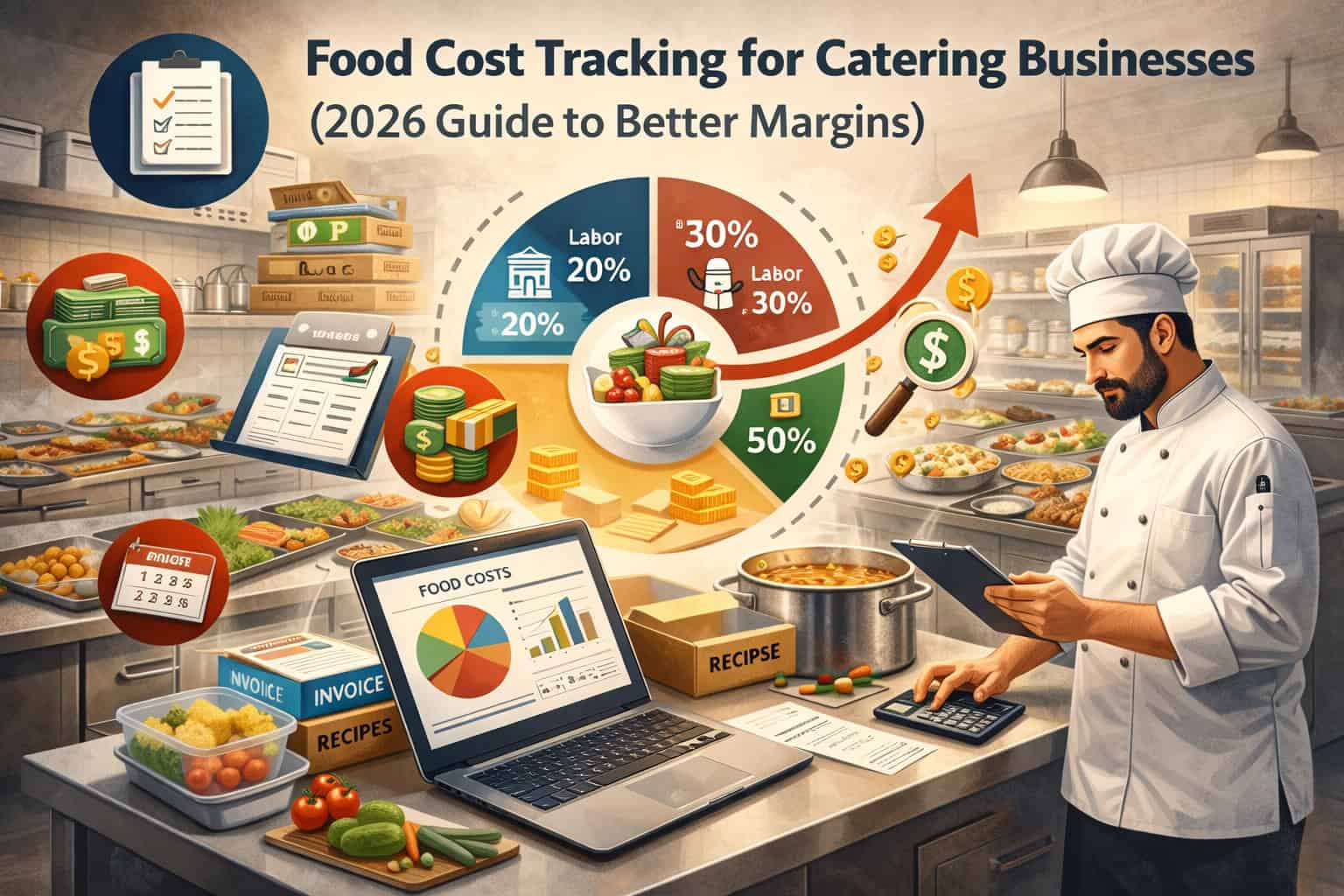
Food cost tracking for catering businesses isn’t just “restaurant food cost, but bigger.” Catering lives in the real world of variable headcounts, unpredictable timelines, off-site cooking conditions, and last-minute changes that can turn a profitable menu into a margin leak.
If you want tighter margins in 2026, you need a system that makes it easy to track food costs in a catering business at three levels:
- Ingredient level (what things cost today)
- Recipe/portion level (what each serving should cost with yield and waste baked in)
- Event/package level (what you expected vs. what actually happened)
This catering food cost management guide walks you through a practical setup you can implement with a spreadsheet or software—plus the food cost control strategies for caterers that actually hold up on busy event weeks.
You’ll get formulas, worked examples, tables, checklists, a tracking workflow, and a 30/60/90-day plan to improve margins without guessing.
Why food cost tracking is different in catering
Catering is a margin game where the rules change every event. A restaurant sells the same dish hundreds of times under controlled conditions. Catering sells a promise: the right food, hot and on time, for a moving target of guest counts, service styles, venues, and constraints.
Here’s what makes food cost tracking harder—and why your system needs event-level accountability:
- Variable headcounts and guarantees: Final counts arrive late, and your “guaranteed minimum” might be lower than your actual attendance. Overproduction becomes silent waste, especially for buffets.
- Service style shifts cost structure: Buffet vs plated cost differences are real: buffets require more safety stock and tend to drive higher overproduction, while plated service pushes higher precision (and often more labor).
- Logistics create hidden costs: Packing lists, transport time, hot holding, and venue limitations affect yield, spoilage risk, and what food returns to your kitchen.
- Menu packages blur margins: Packages bundle high-cost items (proteins, premium sides) with low-cost items (starches, salads). If you don’t track contribution margin for catering menus, you can sell “busy” events that are barely profitable.
- Client changes happen late: Dietary swaps, add-ons, and upgrades can happen inside your prep window. If your system can’t quickly update recipe costs and package pricing tiers, you’ll miss margin.
The core numbers you must understand (without finance jargon)
You don’t need an accounting degree to run strong catering margins. You need a few core numbers that stay consistent across events, menus, and seasons. The goal is to make these numbers easy to calculate, easy to review, and hard to ignore.
At minimum, you should be fluent in:
- Food cost percentage
- COGS (cost of goods sold)
- Contribution margin
- Yield loss and waste
When your team speaks the same “numbers language,” you can spot problems faster: portion creep, vendor spikes, mis-priced packages, or buffet overproduction.
Food cost percentage (what it is and why it can mislead in catering)
Food cost percentage is useful, but it’s not the whole story—especially in catering. In a restaurant, it can indicate operational discipline. In catering, it can be distorted by packaging, rentals, venue fees, and labor-heavy service styles.
Formula (plain text):
Food Cost % = (Food Cost / Food Sales) × 100
The key is defining Food Cost consistently. Many caterers track “food only” and forget disposables, packaging, tasting costs, staff meals, and condiments. Decide what you include and stick to it.
A practical approach is to use two lenses:
- Food-only cost % (ingredients, including yield loss)
- Total edible + service consumables % (ingredients + disposables/packaging you treat as COGS)
COGS (Cost of Goods Sold) for catering: what counts and how to keep it clean
COGS is the cost of what you sold during a period. For catering, that means the ingredients and related consumables tied to events that happened in that timeframe, not simply what you purchased.
Simple COGS formula (plain text):
COGS = Starting Inventory + Purchases – Ending Inventory
In catering, the trap is that you might purchase on Tuesday for a Saturday event. If you record purchases as COGS immediately, your week-to-week margin will look chaotic. That’s why good inventory management for caterers matters even if you keep it lightweight.
A clean approach:
- Track purchases weekly (for cashflow awareness)
- Track COGS monthly (for accurate margin reporting)
- Track per-event actual usage (for real operational improvement)
Contribution margin (your most useful menu metric)
Contribution margin is what’s left after food cost—before labor and overhead. For catering menus, it’s a powerful way to compare items and packages fairly.
Formula (plain text):
Contribution Margin = Selling Price – Food Cost
You can calculate it:
- Per person for packages
- Per tray for buffet items
- Per plated entrée for à la carte
Why it matters: You might have a package that looks “premium” but carries low margin because the protein, garnish, and waste risk are high. Contribution margin helps you price tiers and add-ons strategically.
Yield, trim, cook loss, and waste (where margins leak quietly)
Yield loss is the gap between what you buy and what you can actually serve. In catering, ignoring yield is one of the biggest reasons pricing fails.
Examples of yield loss:
- Trim loss: fat, peel, stems, bones
- Cook loss: shrinkage after roasting, grilling, braising
- Spoilage: product expiring before use
- Overproduction: extra buffet pans that never get served
You’ll want to capture yield in your catering recipe costing so portion costs reflect reality.
Basic yield idea (plain text):
Edible Yield % = (Edible Weight / As-Purchased Weight) × 100
If your edible yield is 80%, you’re paying for 20% that won’t become servings unless you repurpose it.
The KPI table: what to measure and how often
You don’t need 30 reports. You need a short set of KPIs that connect purchasing, production, and event outcomes. Here’s a practical set you can review without drowning in data.
Table 1: Key catering food cost KPIs
| KPI | Definition | How to calculate (plain text) | How often |
|---|---|---|---|
| Food Cost % | Food cost relative to food sales or package revenue | (Food Cost / Food Sales) × 100 | Monthly + per-event spot checks |
| COGS | Cost of goods sold for period | Starting Inv + Purchases – Ending Inv | Monthly |
| Contribution Margin (per person) | Revenue per guest minus food cost per guest | Price per person – Food cost per person | When pricing + monthly review |
| Portion Cost | Expected cost for one serving | Sum(ingredient unit cost × usage) + allocated yield/waste | Per recipe update |
| Yield Loss % | Loss from trim/cook | (AP qty – EP qty) / AP qty × 100 | Per key ingredient quarterly |
| Vendor Price Variance | Price change vs last cost | (Current – Last) / Last × 100 | Weekly |
| Event Variance (Food $) | Actual food cost vs expected | Actual food – Expected food | Per event |
| Event Variance (%) | Event cost performance | (Actual – Expected) / Expected × 100 | Per event |
| Waste % | Waste relative to purchases or production | Waste $ / Purchases $ × 100 | Weekly + per event |
| Buffet Overproduction Rate | Extra servings produced vs served | (Produced – Served) / Served × 100 | Per buffet event |
Pro Tip: If you only adopt two habits, choose vendor price variance weekly and event variance per event. Those two prevent slow leaks from becoming “how did we lose money this month?”
Step-by-step: how to track food costs in a catering business (2026 workflow)
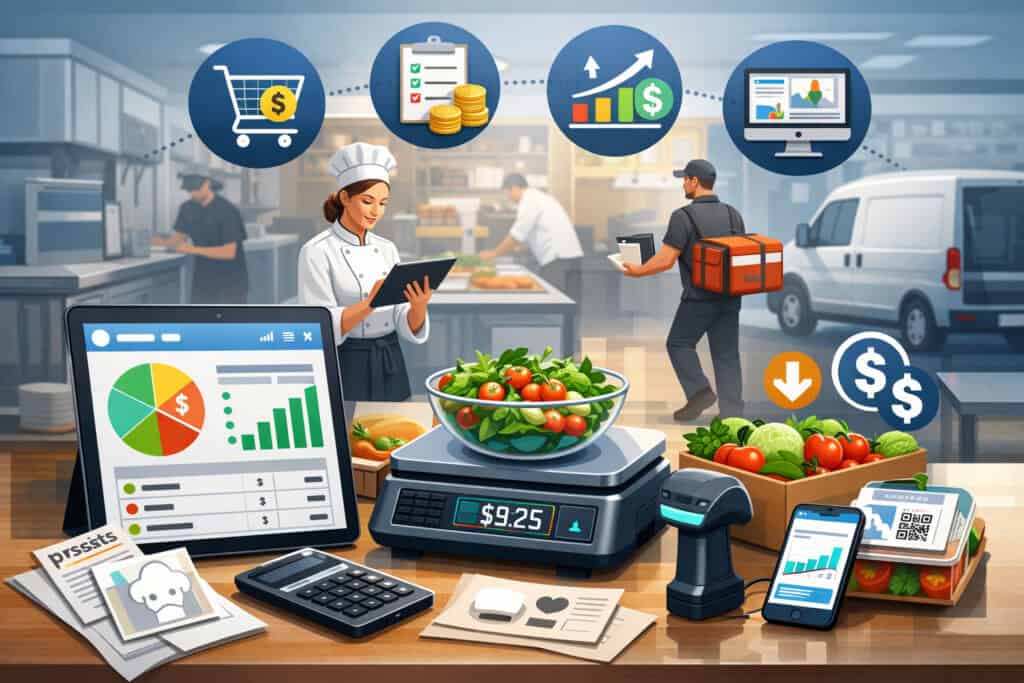
To track food costs in a catering business, you need a workflow that matches how catering actually runs: estimate → purchase → produce → pack → serve → reconcile. The best systems don’t depend on one “spreadsheet hero.” They create repeatable steps that a kitchen manager can run even during peak season.
Below is a step-by-step tracking workflow you can implement with an ingredient cost spreadsheet or with inventory + costing software.
Step 1: Build an ingredient master list that doesn’t fall apart
Start with an ingredient master list (sometimes called an item master). This is the foundation for every cost calculation you’ll do.
Your master list should include:
- Item name (standardized, no duplicates)
- Vendor and preferred brand/spec
- Purchase unit (case, bag, lb, bottle)
- Pack size (e.g., 6 × 2.5 lb)
- Unit cost (as purchased)
- Base unit conversion (oz, lb, each, ml)
- Yield factor (if relevant)
- Last updated date
The biggest mistake is mixing units inconsistently. If one recipe uses “tomatoes (each)” and another uses “tomatoes (lb),” your costing will drift.
Pro Tip: Standardize to one “base unit” for costing. Many kitchens choose ounces or grams for precision, but pounds work fine if you’re consistent.
Step 2: Set up vendor price tracking so changes don’t surprise you
Vendor price tracking is where most catering margins are won or lost. Prices move. Specs change. Substitutions show up on invoices. Your system needs a consistent rhythm.
Minimum viable tracking:
- Track last price and current price
- Flag items with >X% change (choose a threshold that fits your operation)
- Record changes weekly (or whenever invoices are entered)
Practical workflow:
- Enter invoice prices (or import them from software).
- Update ingredient master list for items purchased.
- Review the “price change” column.
- Decide: accept, negotiate, substitute, or reprice menus.
Pro Tip: Make substitutions a rule-based decision, not an emotional one. If chicken breast spikes, you need approved alternates that protect quality and margin.
Step 3: Build standardized recipes that include yields and realistic portions
Standardized recipes are your costing engine. Every catering item should exist as a recipe with:
- Ingredients in base units
- Production yield (total portions produced)
- Portion size (by weight/volume)
- Prep notes that affect yield (trim, cook method)
- All consumable add-ons (sauces, garnishes, dressing, condiments)
Catering recipe costing fails when recipes are “chef memory.” That’s fine until your lead cook is off, a new prep team steps in, or you scale volume.
Pro Tip: Put “portioning method” inside the recipe: scoop size, ladle size, slice count per tray, or target finished weight per portion. Portion control for caterers is operational, not theoretical.
Step 4: Cost each recipe, then calculate per-portion cost
Once recipes exist, costing becomes math. Your goal is to determine the portion cost you expect to serve.
Formula (plain text):
Portion cost = (Ingredient unit cost × usage) + allocated waste/yield loss
Allocation matters. If you know your yield loss for a protein, bake it in so you’re not undercosting.
What “good” looks like:
- Recipe cost updates automatically when ingredient costs update
- Portion cost is visible and used in pricing decisions
- Recipe yields match what your team actually produces
Pro Tip: If your software can’t handle yield well, add a “yield multiplier” line item. Example: if brisket edible yield is 70%, multiply as-purchased cost by (1 / 0.70).
Step 5: Build package costing (per person pricing) with realistic buffers
Packages drive catering. You need a costing method that’s consistent across menus and flexible enough for different service styles.
Start with:
- Package components (entrée, sides, salad, bread, dessert, beverages)
- Portion assumptions by style (buffet vs plated)
- Add-ons (extra protein, premium sides, late-night snacks)
Then compute:
- Total food cost per guest
- Total contribution margin per guest
- Suggested price per guest for target margin
Pro Tip: Buffets need explicit overproduction assumptions. If you don’t plan for it, you’ll be surprised by it every time.
Step 6: Tie recipes to event production sheets (BEOs), prep lists, and packing lists
Food cost tracking becomes real when it connects to execution. That means linking recipes and quantities to your event production sheets (BEOs).
Your BEO should drive:
- Prep lists (what to prep, how much, when)
- Packing lists (what leaves the kitchen)
- Pull sheets (inventory and cooler pulls)
- Final count assumptions and last-minute changes
When BEOs and costing are disconnected, you’ll have accurate recipe costs—but inaccurate event costs.
Pro Tip: Put a “costing snapshot” on every BEO: expected food cost per guest, expected total food cost, and key high-cost items. It focuses the team.
Step 7: Track actual vs expected after each event (the step most teams skip)
Per-event reconciliation is where your margins improve. Even a simple process is powerful:
- Expected food cost (from recipes × event quantities)
- Actual food used (from pulls, production, and leftovers handling)
- Waste/spoilage recorded
- Variance explained and categorized
Variance categories that help:
- Guest count change
- Overproduction (buffet)
- Portioning drift
- Vendor price changes not updated
- Prep error/spoilage
- Client add-ons not billed
Pro Tip: Variance is not to blame—it’s learning. Your goal is to create a feedback loop so your next forecast is tighter.
Costing formulas + worked examples (buffet tray, boxed lunch, plated entrée)
Formulas are only useful if they show up in everyday decisions. Below are realistic examples you can mirror in your own ingredient cost spreadsheet or costing software.
Example 1: Buffet tray costing (roasted vegetable tray)
Scenario: A roasted vegetable tray for a buffet line. You sell it as an à la carte tray add-on or include it inside a package. Yield loss matters (trim and roast shrink).
Assumptions:
- You purchase 12 lb mixed vegetables (as purchased).
- Average edible yield after trim: 90%.
- Roast shrink: 12% of edible weight.
- Final edible cooked yield = 12 lb × 0.90 × (1 – 0.12)
Compute yield:
- Edible pre-cook = 12 × 0.90 = 10.8 lb
- Cooked yield = 10.8 × 0.88 = 9.504 lb
If your tray standard is 9.5 lb finished, that batch makes ~1 tray.
Costs (example structure):
- Mixed vegetables: unit cost per lb × 12 lb
- Oil, seasoning, herbs: costed as small line items
- Garnish: costed
- Disposable pan/lid (if included as COGS): costed
Portion/Tray cost (plain text):
Tray cost = sum(all ingredient costs) + pan/lid cost
Where many caterers lose margin: they cost based on 12 lb becoming 12 lb. In reality, it becomes ~9.5 lb cooked. If you don’t incorporate yield loss, you underprice trays and your buffet package looks better on paper than in practice.
Pro Tip: For buffet trays, create a “finished weight standard” and teach production teams to hit it. That’s portion control at a tray level.
Example 2: Boxed lunch costing (sandwich + side + cookie)
Boxed lunches are deceptively tricky because packaging costs can rival ingredient costs, and portion creep is common (extra chips, bigger cookie, added condiments).
Assumptions:
- Package price: 15.00 per box (example)
- Ingredients:
- Sandwich: bread, protein, cheese, produce, condiments
- Side: chips or salad cup
- Dessert: cookie or brownie
- Packaging:
- Box, napkin, cutlery kit, label/sticker
Food Cost % formula (plain text):
Food Cost % = (Food Cost / Food Sales) × 100
If food + packaging cost per box is 5.10:
- Food cost % = (5.10 / 15.00) × 100 = 34%
Now contribution margin per box:
Contribution Margin (plain text):
Contribution Margin = Selling Price – Food Cost = 15.00 – 5.10 = 9.90
In boxed lunches, the fastest fixes often come from:
- Locking portion standards (e.g., chips 1.5 oz bag, cookie 2 oz)
- Auditing packaging kits (avoid double-napkins, extra cutlery)
- Vendor price tracking on proteins and packaging
Pro Tip: Treat packaging as a tracked line item, not an afterthought. Ignoring it makes box programs feel profitable until the month-end review.
Example 3: Plated entrée costing (chicken + starch + veg + sauce)
Plated service usually reduces buffet overproduction but increases precision expectations and sometimes increases waste risk from timing and holding.
Assumptions:
- Selling price per plated entrée: 38.00 (as part of package allocation)
- Ingredients per plate:
- Chicken (as purchased) 8 oz portion target cooked
- Starch 5 oz cooked
- Veg 4 oz cooked
- Sauce 2 oz
- Chicken yield:
- If using bone-in, trimmed, or cooked shrink, adjust yield factor
Portion cost formula (plain text):
Portion cost = (Ingredient unit cost × usage) + allocated waste/yield loss
If chicken AP cost is 4.00 per lb and yield to cooked portion is 70%:
- Effective cooked cost per lb = 4.00 / 0.70 = 5.71 per lb cooked
If your cooked chicken portion is 8 oz (0.5 lb):
- Chicken cost per plate ≈ 5.71 × 0.5 = 2.86
Add starch, veg, sauce, garnish, and any plate-level consumables. Then compare your portion cost to your allocated selling price.
Pro Tip: For plated menus, build a “plating loss” buffer if you regularly remake plates due to timing errors, dropped plates, or expo adjustments. Even a small rate matters at volume.
Example costing template you can copy (menu item + package)
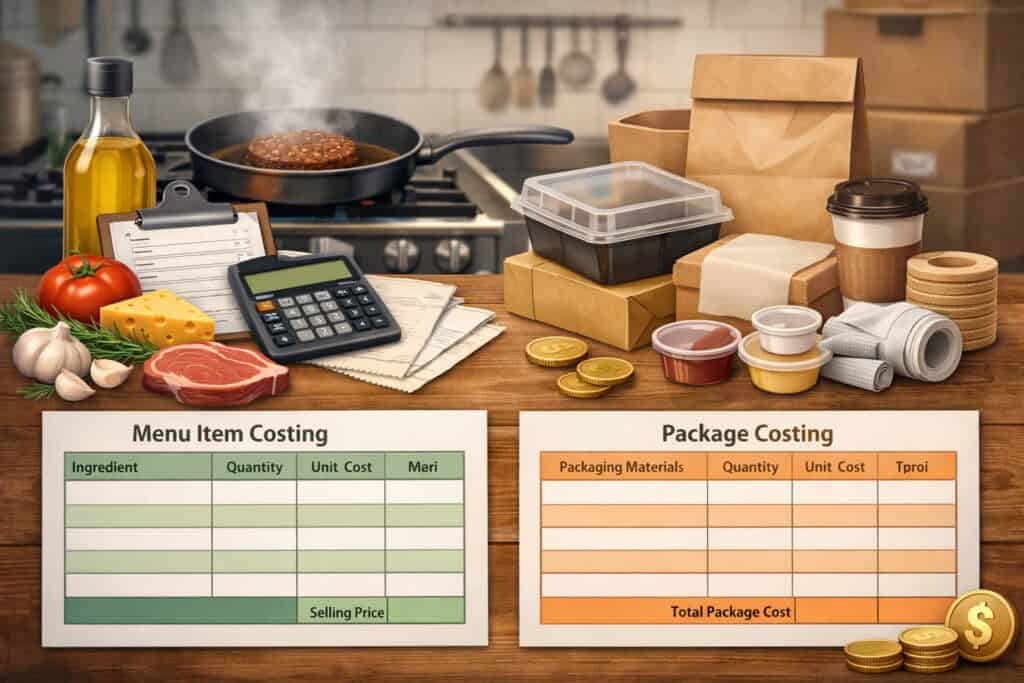
A template helps you standardize how you think about costing—especially when you’re building packages that include multiple components and service styles.
Table 2: Example costing template for a catering menu item/package (text-based)
| Field | Example: “Mediterranean Buffet Package” |
|---|---|
| Service style | Buffet |
| Guest count (guarantee) | 120 |
| Expected servings produced | 135 (includes buffet overproduction buffer) |
| Components | Chicken shawarma, rice pilaf, roasted veg tray, salad, pita, sauces |
| Standard portion assumptions | Chicken 5 oz cooked/guest; rice 6 oz/guest; veg 4 oz/guest |
| Yield factors included? | Yes (chicken 72% cooked yield; veg trim + roast shrink) |
| Expected food cost per guest | 8.40 |
| Packaging/consumables per guest | 0.85 (plates, cutlery, napkins if included) |
| Total COGS per guest (food + consumables) | 9.25 |
| Package price per guest | 22.00 |
| Contribution margin per guest | 22.00 – 9.25 = 12.75 |
| Expected total food + consumables | 9.25 × 120 = 1,110.00 |
| Post-event actuals captured | Leftovers returned, waste logged, protein used, invoice price changes |
| Variance notes | “+8 guests walked in; added 1 extra chicken pan; rice overproduced by 12 portions” |
Pro Tip: Put this template behind every package you sell. It turns pricing from gut-feel into a repeatable process.
Operational workflow: purchasing → receiving → storage → production → packing → event → leftovers → reporting
Food cost tracking becomes reliable when it matches real operations. This section is your “how it should flow” blueprint so the numbers don’t get separated from the work.
A strong operational chain looks like:
- Purchasing based on forecast, par levels, and BEOs
- Purchase orders and receiving checks to confirm pricing and specs
- Storage/FIFO to reduce spoilage and prevent “lost” product
- Production aligned to standardized recipes and yield assumptions
- Packing aligned to packing lists and event requirements
- Event execution with portioning and replenishment rules
- Leftovers handling with clear safety, donation, and repurpose policies
- Reporting that captures expected vs actual and turns into decisions
Purchasing and ordering: the bridge between forecast and cost control
Purchasing is where you lock in costs and reduce chaos. If you order from memory, you’ll overbuy “just in case” and then wonder where margins went.
Practical habits:
- Use a purchasing calendar by event type (weddings vs corporate lunches vs drop-off)
- Set par levels for pantry staples and high-velocity items
- Build an order worksheet tied to BEO counts and standard portions
If you’re scaling, a basic PO system helps you:
- Reduce “phantom” purchases
- Align receiving to expected price and quantity
- Improve vendor negotiations with consistent volume
Pro Tip: Add one column to your ordering sheet: “Is this item tied to an event?” It forces discipline and improves post-event reconciliation.
Receiving and invoice checks: catching cost and spec drift early
Receiving is a cost control moment—not just a box-check. If your team doesn’t verify invoice pricing and specs, vendor price tracking becomes meaningless.
Receiving checklist essentials:
- Confirm quantity received matches PO/invoice
- Confirm pack size and spec (brand, grade, trim)
- Record substitutions
- Record price changes immediately
- Label and date product for FIFO
Even a 3–5 minute receiving discipline per delivery prevents weeks of inaccurate recipe costs.
Pro Tip: If you can’t check every item, check the top 20 cost drivers: proteins, oils, dairy, specialty produce, and disposables.
Storage, FIFO, and inventory management for caterers (without overcomplicating it)
Inventory discipline reduces spoilage and “emergency buying,” which is often the most expensive buying.
Simple standards:
- FIFO labeling (date received + use-by guidance)
- Dedicated “event shelf” for each event’s pulled product
- Weekly cooler walk with a waste/spoilage log
- Key-item counts weekly; full counts monthly (if possible)
Pro Tip: Track spoilage as a reason code: expired, temp issue, over-prep, damaged. The reason is what you can fix.
Production, packing, and event execution: portion control and replenishment rules
This is where portion control for caterers either holds…or collapses. Catering teams often overproduce because it feels safer. The fix is clear standards and replenishment rules.
Examples of standards:
- Buffet protein: replenish in smaller pans more often
- Pre-portion certain high-cost items (desserts, premium proteins)
- Use ladles/scoops that match recipe yield assumptions
- Set a “last pan” rule (don’t open a new pan in the final X minutes unless approved)
Packing lists should match the BEO exactly and include:
- Product quantities
- Serving utensils by menu item
- Backup portions (explicitly defined, not random)
- Condiments and disposables (tracked)
Pro Tip: Buffet control improves dramatically when you stop “building the whole buffet in the kitchen.” Stage backups and replenish intentionally.
Leftovers handling and reporting: turning returns into data, not mystery
Leftovers are either waste, future value, or liability. You need a clear policy and a tracking method.
Operational steps:
- Separate unused, safe, intact product from served product
- Record what returned by item and approximate quantity
- Decide: repurpose, staff meal, donation, discard (based on your standards)
- Log waste/spoilage with reason codes
- Feed the data into your next forecast
Pro Tip: If you don’t record returns, you’ll keep overproducing because your team never “feels” the cost.
Food cost control strategies for caterers that actually work

Control strategies only work when they fit catering realities: time pressure, multiple events, varying venues, and staffing changes. These tactics are practical because they link directly to execution and measurable KPIs.
Portion control standards (the fastest margin stabilizer)
Portion creep is often unintentional: a bigger scoop, a heavier protein slice, a generous garnish. Multiply that by 150 guests and your event margin changes.
Practical portion control tools:
- Standard scoops/ladles with labeled sizes
- Protein slicing guides (weight targets per slice)
- Tray build standards (finished weight per pan)
- “Test plate” photos for plated meals (visual standard)
- Pre-portioned items for high-cost components
Make portioning part of training:
- Teach why the standard exists (profitability + consistency)
- Audit during production and during event replenishment
- Celebrate accuracy, not “generosity”
Pro Tip: For high-cost proteins, weigh the first 10 portions of every event. If you’re off by even 0.5 oz, fix it before you produce the full batch.
Batch prep and forecasting by event type (stop reinventing every week)
Forecasting improves when you categorize events and build “known patterns.”
Create event templates:
- Corporate drop-off lunch (predictable attendance, box-friendly)
- Wedding buffet (higher overproduction risk, longer service windows)
- Plated gala (precision + labor intensity)
- Backyard party (variable service, weather risk)
For each template, define:
- Typical overproduction buffer by category (protein vs sides)
- Packaging needs
- Most common waste points
- Staffing assumptions (high-level)
Then use actual vs expected data to refine your buffers over time.
Pro Tip: Buffers should be item-specific. You might need a bigger buffer for salad and bread than for an expensive protein.
Par levels and purchasing calendars (reduce emergency buys)
Emergency buying is expensive and disruptive. Par levels keep you from running out while avoiding overstock.
What to set pars for:
- Pantry staples (oil, flour, spices)
- High-velocity disposables (boxes, lids, cutlery kits)
- Common produce and dairy items (based on your menu mix)
- Cleaning and safety consumables (gloves, foil, wrap)
Create a purchasing rhythm:
- Weekly: perishables and key event items
- Biweekly: disposables and pantry refills
- Monthly: bulk items and vendor negotiations
Pro Tip: Track “emergency buys” as a KPI. If you’re doing them often, your planning system—not your vendor—is the issue.
Receiving and invoice checks (protecting your recipe costing)
If invoice prices change but recipes don’t, your menu pricing drifts out of profitability. Build a simple control:
- If an invoice item changes price beyond your threshold, it triggers:
- Recipe cost update for affected recipes
- Package cost review if the ingredient is a key driver
- Substitution or negotiation decision
Pro Tip: Don’t update everything daily. Update key cost drivers weekly and do a broader refresh monthly.
Substitution rules when prices spike (without hurting quality)
Substitution should be structured. Otherwise, teams substitute inconsistently and your menu quality varies.
Create rules like:
- Approved alternate brands/specs per key ingredient
- Price spike thresholds that trigger substitution review
- “No-substitute” items that define your brand quality
- Client communication guidelines if a visible ingredient changes
Use vendor price tracking to anticipate spikes and plan seasonal menu shifts.
Pro Tip: Build add-ons that absorb volatility: premium sides, upgrades, and dessert enhancements with strong contribution margins.
Waste logs and post-event reconciliation (your continuous improvement engine)
Waste tracking and spoilage doesn’t need to be complicated. It needs to be consistent.
Waste log basics:
- Date and event
- Item
- Quantity (estimate is okay)
- Reason code (overproduction, expired, prep error, returned served food)
- Dollar estimate (optional early on)
Then reconcile after each event:
- Expected food cost from recipes
- Actual usage based on pulls and returns
- Variance explanation
Pro Tip: Focus your first improvements on the top 5 recurring waste items. Fixing everything at once is how teams quit tracking.
Tools and systems in 2026: spreadsheets, software, and integrations
The right tool depends on your volume, complexity, and team discipline. A spreadsheet can work beautifully—until it doesn’t. Software can help—until it’s implemented poorly. The best choice is the one that your team will actually use every week.
Spreadsheet approach (beginner-friendly and effective)
A spreadsheet system can deliver strong results if it’s structured. The goal is to maintain:
- Ingredient master list with vendor pricing
- Recipe costing sheets with yields and portions
- Package costing calculator per person
- Event reconciliation worksheet (expected vs actual)
- Waste tracking sheet
An ingredient cost spreadsheet should include:
- Item, vendor, pack size, base unit, unit cost
- “Last price” and “current price” columns
- Automatic unit conversion to your base unit
Where spreadsheets struggle:
- Multiple users editing simultaneously
- Too many versions floating around
- Manual data entry from invoices
- Inconsistent recipe updates
Pro Tip: Lock down the master list. One owner for ingredient costs, one owner for recipe standards, and a simple weekly update schedule.
Inventory + costing software approach (growth stage)
Software for catering cost control becomes valuable when:
- You have high event volume
- You need multi-user access
- You want invoice importing
- You need stronger inventory and COGS reporting
- You want easier recipe scaling and BEO linkage
Look for features that match catering:
- Recipe costing with yield handling
- Vendor catalog and price tracking
- Purchase orders and receiving
- Inventory counts and FIFO support
- Event production sheets integration or export
- Event-level reconciliation reporting
Implementation best practice:
- Start with your top 50 ingredients and top 20 recipes
- Train with real events, not “demo menus”
- Build weekly habits before adding complexity
Pro Tip: Software won’t fix weak standards. Standard recipes and portion rules come first, then software scales them.
POS/accounting integration concepts (high-level, practical)
You don’t need a complicated tech stack. You need consistent data flow:
- Sales data (event revenue, packages, add-ons)
- Purchasing data (invoices, item costs)
- Inventory/COGS data (period-level accuracy)
- Event-level reporting (variance and waste)
Even basic integration goals help:
- Ensure event revenue is categorized consistently
- Map purchases to COGS categories
- Avoid double-entry where possible
Pro Tip: The integration you need most is not “system to system.” It’s BEO to production and production to reconciliation.
Common mistakes that destroy catering margins (and how to avoid them)
Most margin problems aren’t dramatic. They’re small missteps repeated across dozens of events until the month-end numbers look confusing and disappointing.
Here are the mistakes to watch, with practical fixes.
Pricing without yield factors (the silent underpricing problem)
If you price a protein dish based on as-purchased cost, you’re likely underpricing. Yield loss (trim/cook loss) can swing your cost meaningfully.
Fix:
- Apply yield factors to your top proteins first
- Update yield assumptions quarterly or when suppliers change specs
- Train teams to portion based on finished weight
Pro Tip: Make yield visible on the recipe card. If the team sees it, they respect it.
Ignoring disposables and packaging costs
Packaging can be a major cost driver for drop-off catering and boxed lunches. If you don’t include it in costing, you’ll misread your margins.
Fix:
- Create a packaging “recipe” per service style (box, buffet, plated)
- Cost it per guest or per order
- Update when vendors change pricing
Pro Tip: Standardize packaging kits. Variety feels premium—but it often creates waste and higher ordering complexity.
Not tracking buffet overproduction
Buffet events often create extra pans that never get served. If you don’t measure it, you’ll keep doing it.
Fix:
- Track produced servings vs served servings
- Set explicit buffer rules by item type
- Replenish in smaller batches
Pro Tip: Overproduction isn’t generosity if it ends up in the trash. It’s an unpriced cost.
Inconsistent portioning and “helpful” staff behavior
Teams often want to exceed expectations. Without portion standards, that behavior becomes margin loss.
Fix:
- Use consistent tools (scoops, ladles, slicers)
- Build a culture of consistency
- Audit portioning during production and service
Pro Tip: Consistency is a customer experience advantage, not just a cost-control technique.
Not updating recipes after vendor price changes
If your recipe costs are outdated, your pricing decisions are based on yesterday’s reality.
Fix:
- Weekly update of key cost drivers
- Monthly refresh of all active ingredients
- Trigger updates when price variance exceeds your threshold
Pro Tip: If you can’t update everything, update the ingredients that drive 80% of cost: proteins, dairy, oils, premium produce, disposables.
Reporting cadence that keeps costs under control
Reporting cadence is what keeps your system alive. If you only review costs monthly, you’ll discover problems after they’ve already happened across multiple events. If you try to review everything daily, the team will burn out.
A realistic cadence balances discipline and sanity.
Weekly checks (keep the system current)
Weekly tasks should take under an hour if your system is set up well.
Weekly checklist:
- Update vendor pricing for purchased items
- Review vendor price variance for key items
- Review waste tracking and spoilage notes
- Check par levels and adjust purchasing calendar
- Confirm recipe updates for any major cost changes
Pro Tip: Schedule weekly cost review on your calmest day. Cost control dies during peak event production weeks unless it’s protected by routine.
Per-event reconciliation (where learning happens)
Per-event reconciliation is the most actionable report you can do. Even if it’s “rough,” it drives improvement.
Per-event steps:
- Confirm final guest count and any changes
- Calculate expected food cost from recipes and portions
- Record actual usage as best as possible (pulls + returns + waste)
- Log variances and assign reason codes
- Decide one improvement for next similar event type
Pro Tip: Keep reconciliation short. One page, one conversation, one actionable improvement.
Monthly margin review (where pricing decisions get made)
Monthly reviews are for decisions that affect the next month:
- Price updates for packages and add-ons
- Menu engineering (swap low-margin items)
- Vendor negotiations based on volume
- Waste reduction targets
- Training needs for portioning and production
Pro Tip: Separate “review” from “implementation.” Make decisions in the monthly meeting, then assign owners and deadlines for changes.
30/60/90-day margin improvement plan (practical and realistic)
This plan focuses on building foundations first, then adding event-level intelligence, then optimizing pricing and purchasing. It’s designed to work for small teams and growing operations.
Days 1–30: baseline + recipe costing setup
Goals:
- Establish ingredient master list
- Begin vendor price tracking
- Standardize top recipes
- Start simple waste tracking
Actions:
- Build your ingredient master list (start with top 100 items)
- Set base units and pack conversions
- Add yield factors for top 10 proteins/produce items
- Create standardized recipes for top 20 menu items
- Cost those recipes and define portion standards
- Start a simple waste log with reason codes
Deliverables:
- Ingredient cost spreadsheet or software item master
- 20 costed recipes with portions and yields
- Weekly vendor price update routine
Pro Tip: In month one, don’t chase perfection. Chase consistency and adoption.
Days 31–60: event-level tracking and variance reviews
Goals:
- Connect costing to BEOs and production
- Reconcile actual vs expected on real events
- Identify top variance drivers
Actions:
- Add costing snapshot to BEOs (expected food cost per guest + total)
- Build prep lists and packing lists from standardized recipes
- Track actual usage for at least 8–12 events (or every event if volume is low)
- Categorize variances consistently (overproduction, portion creep, price changes, etc.)
- Implement one buffet replenishment rule and one portion audit habit
Deliverables:
- Event reconciliation template
- Variance log with reason codes
- Updated forecasting assumptions by event type
Pro Tip: Don’t wait for perfect inventory data to start. Start with disciplined estimates and tighten over time.
Days 61–90: pricing updates, vendor negotiation, waste reduction
Goals:
- Use your data to reprice and redesign packages
- Negotiate with vendors using purchase history
- Reduce top waste categories
Actions:
- Review contribution margin per guest across packages
- Adjust menu pricing for catering packages and add-ons
- Create pricing tiers and add-ons that improve margin without feeling “nickel-and-dime”
- Negotiate on top spend categories; consider alternate specs where it won’t hurt quality
- Improve leftovers handling and repurpose plans to reduce spoilage
- Update recipes affected by ongoing vendor changes
Deliverables:
- Updated package pricing and add-on structure
- Vendor negotiation plan and results
- Waste reduction actions tied to top 5 waste items
Pro Tip: If you change prices, update your sales tools at the same time (quote templates, package sheets, upsell scripts). A pricing change that isn’t used is not a change.
FAQs
Q1) What is a good food cost percentage for catering?
Answer: A “good” food cost percentage depends on your service style, packaging, and what your package includes. Buffet-heavy programs often run higher food cost than plated when overproduction isn’t controlled.
The better approach is to track both food cost % and contribution margin per guest, because contribution margin tells you if the package can support labor and overhead. Use your last 3 months as a baseline, then improve through portion control, waste reduction, and pricing adjustments.
Q2) How do I price catering packages using food costs?
Answer: Start by costing the package per guest: sum the portion costs of each component, then add packaging/consumables if you include them. Decide your target contribution margin per guest and work backward to a selling price.
Packages should also account for buffet buffers or plated precision needs. The goal is consistent pricing logic across tiers and add-ons, so your quotes remain profitable even when sales mixes change.
Q3) How do I account for yield loss in recipe costing?
Answer: Use yield factors for items with trim or cook loss (proteins, certain produce). A practical method is to convert as-purchased cost into edible cooked cost using: effective cost = AP cost / edible yield %.
Then cost portions based on the finished portion size. If you don’t have exact yields, start with conservative assumptions, then refine using production weights over time.
Q4) What’s the easiest way to track food costs for a small catering business?
Answer: Start with a spreadsheet approach: an ingredient master list with pack conversions and unit costs, plus cost standardized recipes for your top menu items.
Add a simple per-event reconciliation worksheet that compares expected vs actual. Even tracking 10 key ingredients and 20 recipes can dramatically improve pricing confidence and waste awareness.
Q5) How often should I update ingredient costs?
Answer: Update key cost drivers weekly (proteins, dairy, oils, disposables), and do a broader refresh monthly for all active ingredients. If you experience volatile pricing, use vendor price tracking thresholds to trigger immediate updates for items that move beyond your set percentage.
Q6) How do I reduce food waste after events?
Answer: First, measure it. Track waste and leftovers by item and reason code. Then set buffet replenishment rules (smaller pans, staged backups), tighten portion standards, and improve forecasting by event type. Also define safe leftovers handling—repurpose, staff meal, donation, or discard—so returns don’t become random spoilage.
Q7) Should I use inventory software for catering?
Answer: If you’re growing, running many events, or struggling with multiple users and version control, software can help—especially with invoice importing, purchase orders and receiving, recipe costing, and inventory counts. But software only works if your recipes and portion standards are real. Build standards first, then let software scale them.
Q8) How do I handle price fluctuations from vendors?
Answer: Use vendor price tracking with a weekly review. Set thresholds that trigger action: negotiate, substitute, adjust portion size, redesign menu components, or reprice packages. Build approved substitutions in advance so you’re not making quality decisions under pressure.
Q9) What’s the difference between COGS and food cost %?
Answer: COGS measures the total cost of goods sold in a period (inventory-based). Food cost % is a ratio comparing food cost to sales.
In catering, food cost % helps with package profitability checks, while COGS supports accurate month-end financial reporting. Ideally, you use both: COGS for the accounting view and food cost % + contribution margin for operational decisions.
Q10) How do I track food costs for buffet vs plated service?
Answer: Track expected portions differently. Buffets require explicit overproduction buffers and careful replenishment rules. Plated service requires precision and sometimes a “plating loss” allowance if remakes happen. Reconcile per event to see how each style performs in your operation, then adjust buffers, portion tools, and pricing.
Q11) How do I include disposables and packaging in food cost tracking?
Answer: Create a packaging kit per service style and cost it per guest or per order. Treat it as part of COGS for event profitability decisions. Update packaging costs when vendor prices change, and standardize kits to reduce ordering complexity and waste.
Q12) How do I use event production sheets (BEOs) for cost control?
Answer: Add a costing snapshot to each BEO: expected food cost per guest, expected total, and key high-cost items. Use BEOs to generate prep lists and packing lists tied to standardized recipes. After the event, use the BEO counts and actual notes to reconcile variance and improve forecasts.
Q13) What’s the best way to prevent portion creep during events?
Answer: Use the right tools (labeled scoops/ladles), set tray finished-weight standards, and audit early in production. For buffets, replenish smaller pans rather than setting out everything at once. For plated meals, use test-plate photos and portion targets by weight.
Q14) How do I track waste without slowing down the kitchen?
Answer: Keep the waste log simple: item, approximate quantity, reason code, event. The estimate is fine early on. Focus on the top 5 waste drivers and fix those first. Waste tracking should be quick enough that the team actually does it.
Q15) How do I know if my menu pricing tiers and add-ons are working?
Answer: Track contribution margin per guest and sales mix. Add-ons should have strong margins and be easy to execute operationally. Review monthly: which tiers sell, which add-ons attach, and whether events with certain add-ons perform better on variance and waste.
Conclusion
Better margins in catering come from visibility and repetition. When you consistently track ingredient costs, cost recipes with yield in mind, build package pricing from portion costs, and reconcile per event, you stop guessing. You start learning.
Food cost tracking for catering businesses works best when it’s integrated into how you already operate—purchasing, production, packing, and post-event reporting—rather than treated as an “office task” that happens only when margins look bad.