
By Todd Johnson September 8, 2026
Meal-prep subscription billing works best when the billing calendar follows the kitchen calendar. A reliable meal prep subscription billing setup should let customers edit, skip, or pause before a clearly stated cutoff; charge eligible orders early enough to resolve payment failures before production becomes financially irreversible; and keep unpaid orders out of production when payment cannot be recovered in time.
That makes weekly meal subscriptions operationally different from many conventional subscriptions. A streaming service can often retry a failed payment without worrying that chicken has already been portioned, vegetables have been prepped, labels have been printed, and delivery routes have been built. A meal-prep operator cannot.
The core sequence is:
Active subscription → menu opens → customer edits or skips → cutoff locks the order → payment runs → failed payments enter recovery → paid orders release to production → meals are delivered → next week’s subscription state continues.
A strong system therefore needs more than a recurring-payment button. It must synchronize subscription state, order state, payment state, menu selection, purchasing, kitchen production, and fulfillment.
This guide focuses specifically on that weekly operating engine. It is not individualized legal advice, and businesses should review applicable federal and state automatic-renewal laws, card-network requirements, ACH rules, processor requirements, and their own customer terms with appropriate advisors.
How Meal Prep Subscription Billing Setup Should Work
A meal prep subscription billing setup should begin with the production calendar rather than with the payment processor’s default recurring-billing schedule.
At minimum, the system needs to know seven things for every subscription week:
- Whether the subscription is active.
- Which meals or plan the customer selected.
- When changes and skips stop being accepted.
- When payment will be attempted.
- Whether that payment succeeded.
- When the kitchen commits ingredients and labor.
- When the resulting order will be delivered.
Those events should form one operational chain rather than independent schedules.
Consider the basic workflow:
Customer active
→ menu available
→ customer edits or skips before cutoff
→ cutoff locks order
→ payment runs
→ payment succeeds
→ order becomes production-eligible
→ kitchen produces meals
→ delivery occurs.
If payment fails, the path changes:
Payment fails
→ order becomes payment pending
→ customer receives notice
→ payment method may be updated or retried
→ payment succeeds before production lock
→ order releases to kitchen.
If payment remains unresolved:
Payment remains unpaid
→ production deadline arrives
→ current order is removed or held
→ customer is notified
→ subscription may remain active for the next week.
That final distinction is crucial. A failed order does not automatically mean a failed subscription relationship.
A kitchen that already uses structured inventory controls should make this billing calendar part of the same operating discipline. Cloud Food Manager’s guidance on weekly restaurant inventory audits is relevant because weekly subscriptions create demand commitments that eventually need to reconcile to purchasing, production, and usage.
Table 1: Illustrative Weekly Billing Calendar
| Stage | Illustrative Timing | Customer Action | System Action |
| Menu opens | Monday | Choose meals/add-ons | Open next week’s order |
| Edit/skip cutoff | Wednesday 11:59 PM | Finalize, skip, or leave selections | Lock billable order |
| Billing run | Thursday morning | None unless payment issue | Charge eligible subscriptions |
| Recovery period | Thursday-Friday | Update failed payment | Retry where appropriate |
| Production lock | Friday afternoon | Limited/no changes | Release paid orders |
| Fulfillment | Sunday/Monday | Receive meals | Mark fulfilled |
This timeline is illustrative, not a universal recommendation. A business delivering on Wednesday, buying ingredients six days ahead, or producing from multiple kitchens may need a very different schedule.
Anchor Weekly Billing to the Meal Order Cutoff
The meal prep payment cutoff schedule is one of the most important controls in the subscription system.
The cutoff tells the kitchen how many portions it needs to produce. Before that point, demand can still change. Customers may reduce meals, add premium dishes, skip the week, change delivery options, or pause service.
Once the cutoff passes, operations increasingly depend on the order count.
That means the billing run should normally be positioned relative to the cutoff and production lock, not chosen merely because “Thursday is billing day.”
Charging too late creates one set of problems. A card may decline after ingredient orders have been placed, prep has started, labels have been generated, or drivers have been assigned. If the customer never pays, the business may be left with food and labor costs that cannot be recovered.
Charging too early creates a different problem. If customers are charged before the period in which they were told they could change or skip an order, the business may generate avoidable refunds, credits, disputes, customer-service tickets, and dissatisfaction.
An illustrative sequence might be:
Wednesday 11:59 PM — edit/skip cutoff
Thursday morning — billing run
Thursday-Friday — failed-payment recovery
Friday afternoon — production lock
Sunday/Monday — delivery
Again, the exact days are not the point. The ordering relationship is.
The billing event should usually occur after the applicable customer-selection cutoff but sufficiently before the kitchen’s irreversible production deadline.
For operators using lean purchasing, the relationship can be especially tight. Cloud Food Manager’s discussion of just-in-time inventory management illustrates why demand timing, supplier timing, and production timing need to remain synchronized.
How Far Before Delivery Should You Charge?
There is no defensible universal answer such as “always charge three days before delivery.”
Instead, work backward from the operational commitments that matter to your business.
Consider:
- Ingredient purchasing: When must suppliers receive final quantities? If protein or specialty ingredients are ordered Friday morning, waiting until Friday afternoon to discover card failures may be too late.
- Kitchen prep: When do employees start batch preparation, marinating, cooking, portioning, or packing?
- Menu finalization: Customers should ordinarily have a meaningful opportunity to make permitted changes before the system treats the order as final.
- Delivery routing: When are delivery zones, driver manifests, labels, insulated containers, or third-party delivery orders finalized?
- Payment recovery: How much time does your processor’s permitted retry strategy and customer payment-update workflow require?
The practical rule is:
Charge early enough to resolve a reasonable number of payment failures before irreversible food cost is committed, but not so early that customers are charged while their promised modification window remains open.
This is a business-process decision, not merely a payment-processing setting.
Weekly Recurring Billing for Meal Prep Businesses

Weekly recurring billing meal prep operations have a different rhythm from monthly membership billing.
A monthly business may have several weeks to recover a failed renewal. A meal-prep business may have only a day or two between the final menu decision and ingredient or production commitment.
Weekly subscriptions also create more frequent customer-state changes.
A customer might:
- receive meals this week,
- skip next week,
- receive the following week,
- pause for three weeks,
- resume on a specific date,
- add two premium meals,
- then reduce the plan.
The billing architecture needs to tolerate these transitions without turning each change into account cancellation and re-enrollment.
Common weekly models include:
Fixed weekly plan. The customer receives the same meal count at a predetermined base price.
Variable basket. The customer starts with a plan but changes meal quantities or add-ons each week.
Customer-selected meals. The subscription establishes recurring participation while the week’s actual basket comes from individual selections.
Minimum weekly commitment. The customer may choose different items but must meet a defined meal or spending minimum.
Because each model calculates charges differently, the recurring authorization and signup experience should accurately explain how the weekly amount is determined.
The kitchen also needs visibility into the resulting billable quantity. This is where operational systems should connect billing data with ingredient planning. Cloud Food Manager’s guide to setting up kitchen inventory management provides useful background for building that downstream inventory discipline.
How Pause, Skip, and Cancellation Should Work
Skip, pause, cancel, and payment hold should never be interchangeable database labels.
Each represents a different relationship between the subscriber and the current week’s order.
Table 2: Subscription and Order States
| State | Current Week Charged? | Order Created? | Future Subscription? | Production Status |
| Active | Yes, when due | Yes | Active | Eligible after payment |
| Skip | No for skipped week | Suppressed/canceled | Active afterward | None |
| Pause | No while paused | No | Suspended until resume | None |
| Cancel | No future subscription charge | No future subscription order | Closed | None |
| Payment hold | Not successfully paid | Usually yes, but held | Usually remains active | Hold/remove |
This separation prevents a common operational mistake: turning a temporary week-level event into a customer-level cancellation.
Skipping One Week
A skip should suppress one specific subscription cycle.
For a valid pre-cutoff skip:
- no billable order should remain for that week,
- no recurring charge should be generated,
- no production ticket should be released,
- no ingredient demand should be attributed to that order,
- and the subscription should remain active for the following eligible week.
That is the correct pause skip subscription meal delivery distinction: a skip says “not this cycle,” not “end my relationship.”
The system should record which delivery week was skipped rather than merely storing an ambiguous inactive status.
If a customer tries to skip after the disclosed cutoff, the business needs a consistent policy describing whether a late exception, account credit, partial adjustment, or no change is available. The appropriate policy depends on the company’s terms and applicable law.
Pausing Multiple Weeks
A pause suppresses more than one cycle.
Useful pause fields include:
- pause effective date,
- first suppressed delivery week,
- optional scheduled resume date,
- customer-requested versus system-generated pause,
- next eligible cutoff,
- next charge date,
- next delivery date.
While paused, the platform should not quietly create orders and then reverse them. It is cleaner to suppress order generation and billing before those events occur.
If the customer selects an automatic resume date, consider reminding them before service resumes where appropriate. That reduces surprise and gives the customer an opportunity to confirm menu selections, address payment issues, or extend the pause.
Resuming Without Duplicate Charges
Resume logic needs particular care.
A resumed subscription should normally restore the existing relationship rather than requiring the customer to create a brand-new subscription and payment authorization unnecessarily.
The system should determine:
- Which service week is the first active week?
- Has its ordering cutoff already passed?
- Is there already an order for that subscription/week?
- Has any payment already succeeded?
- Is another billing job queued?
The safest operational concept is one billable subscription order per subscriber per service week.
If a customer resumes twice, refreshes a page, or a scheduled job runs more than once, the system should not create two paid orders.
Likewise, a failed-payment retry should update the existing order’s payment state rather than generating another meal order.
Customers should see, before or immediately after reactivation where practical:
Next charge: Thursday, September 10
Next delivery: Sunday, September 13
Those dates remove ambiguity around what “resume” actually means.
FTC Negative Option Requirements for Meal Subscriptions
Recurring meal plans sold online are generally relevant to federal negative-option principles because the consumer continues to be charged unless they take action to stop future participation.
The current federal landscape requires care.
The FTC finalized a broad “Click-to-Cancel” Negative Option Rule in 2024, but the U.S. Court of Appeals for the Eighth Circuit vacated that rule in July 2025 before its principal requirements took effect. In March 2026, the FTC began a new rulemaking inquiry concerning negative-option practices.
That does not mean online subscriptions are unregulated.
The FTC continues to enforce the FTC Act and the Restore Online Shoppers’ Confidence Act, or ROSCA.
Current FTC enforcement materials describe ROSCA as requiring online sellers using negative-option features to clearly and conspicuously disclose material terms, obtain express informed consent before charging, and provide simple mechanisms for stopping recurring charges. Recent 2026 FTC subscription enforcement actions continue to emphasize those principles.
Operators can review the FTC’s current Negative Option Rule and rulemaking materials and its consumer guidance on automatic renewals and negative-option subscriptions.
State automatic-renewal statutes may impose additional requirements, including requirements concerning notices, acknowledgments, cancellation methods, renewals, or material changes. A meal-prep company selling across states should not assume the federal baseline is the entire compliance picture.
Signup Disclosure and Consent
A meal subscription signup flow should explain material billing terms before enrollment.
Depending on the plan, relevant information may include:
- that charges recur weekly,
- the standard amount or method used to calculate it,
- the usual billing cadence,
- the ordering and skip cutoff,
- what happens if the customer takes no action,
- how pause and skip work,
- how cancellation works,
- delivery charges or other applicable fees,
- how variable baskets affect the amount,
- and how price changes are handled.
For card subscriptions, current Visa rules require an agreement for stored-credential use and address disclosures such as how the amount is determined, transaction frequency, and cancellation/refund policies. Visa’s current public rules also contain transaction-identification and stored-credential requirements.
Mastercard likewise defines recurring arrangements and requires subscription billing merchants to follow specific recurring-payment standards; its current transaction-processing rules address recurring transaction indicators, subscription-term disclosures, and retention of the cardholder agreement.
Useful consent evidence can include:
- customer account identifier,
- timestamp,
- version of the recurring terms accepted,
- checkbox/button acceptance event,
- payment token identifier,
- and relevant IP/device metadata where lawfully and appropriately collected.
No single record proves legal compliance in every situation. The objective is to preserve reliable evidence of what the customer was shown and agreed to.
Online Cancellation
An online account should make cancellation reasonably accessible.
For a meal-prep portal, skip, pause, and cancel should appear as separate actions because they do different things.
Do not create a user experience in which:
- “pause” secretly means cancel,
- “skip” is hidden behind multiple retention pages,
- a cancel control only changes marketing preferences,
- or customers believe they canceled while billing continues.
Although the vacated 2024 FTC rule should not be described as imposing a currently effective nationwide “same method” click-to-cancel requirement, ROSCA still requires a simple way for consumers in covered online negative-option transactions to stop recurring charges, and state laws may be more prescriptive.
The FTC’s 2026 Shutterstock matter, for example, specifically alleged failures involving difficult cancellation and lack of informed consent.
What Happens When a Weekly Subscription Charge Fails?
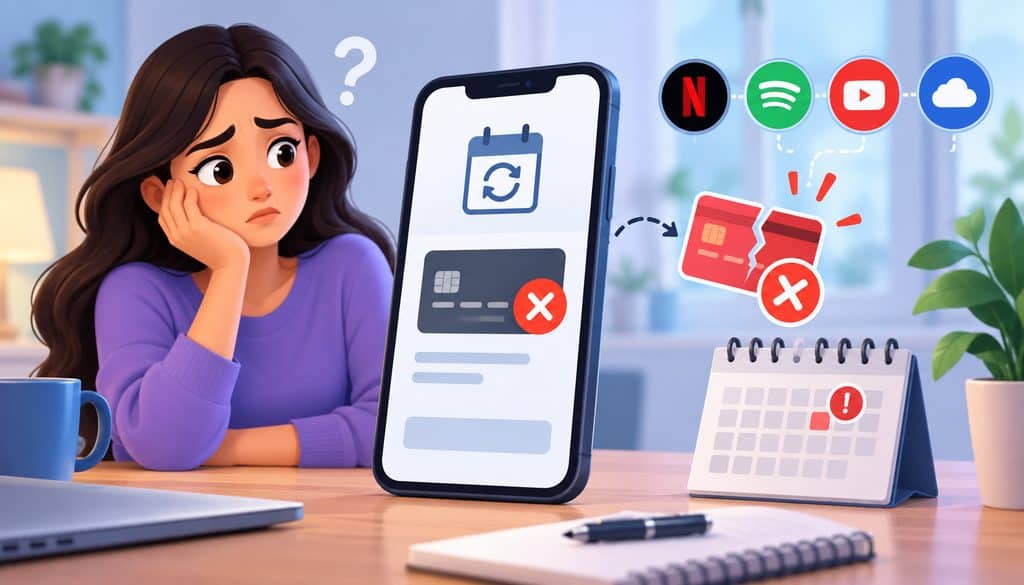
A failed subscription payment food business workflow should start with the order, not with immediate account cancellation.
The desired sequence is:
Scheduled charge fails
→ order becomes payment pending
→ customer receives notice
→ payment method can be updated
→ retry occurs where appropriate
→ successful payment arrives before production lock
→ order becomes production-ready.
If recovery fails:
Payment unresolved
→ final payment deadline arrives
→ order is removed or held from production
→ customer receives confirmation
→ subscription remains available for the next cycle unless policy or customer action changes it.
Table 3: Failed-Payment Recovery
| Stage | Payment Status | Production Status | Customer Message |
| Initial billing | Declined | Hold | Payment unsuccessful |
| Recovery period | Pending | Hold | Update payment by deadline |
| Retry succeeds | Paid | Eligible | Payment confirmed |
| Deadline reached unpaid | Failed | Remove/hold | Delivery will not be produced |
| Following week | New cycle | Depends on new payment | Subscription may continue |
Retry Timing
Meal subscriptions have shorter dunning windows than many monthly services.
An operational approach could involve:
- notifying the customer immediately after the initial failure,
- allowing a secure payment-method update,
- attempting another transaction later when appropriate,
- possibly making another permitted attempt before the kitchen deadline,
- and ending the current week’s recovery sequence once production can no longer reasonably accommodate the order.
That is intentionally not an exact universal retry schedule.
Networks, issuers, acquirers, gateways, and processors provide decline information and may impose retry or resubmission requirements. Mastercard’s current rules, for example, contemplate issuer-provided Merchant Advice Codes for declined recurring transactions, which merchants and acquirers should be able to act upon.
A temporary or “soft” decline can sometimes be recoverable. Examples may include insufficient available funds or temporary issuer conditions.
A “hard” failure may indicate that another payment method is needed. Examples can include a closed account, invalid credentials, or a card reported lost or stolen.
But reason-code treatment varies. Do not hard-code a universal “retry this code three times” policy without using your processor’s current guidance.
When to Pull the Order From Production
The cutoff for payment recovery should precede the point at which the order becomes economically difficult to reverse.
Possible triggers include:
- payment remains unresolved,
- no replacement payment method has been provided,
- permitted recovery actions are exhausted,
- purchasing quantities are about to be finalized,
- prep labor is about to begin,
- or routing/packing commitments are becoming irreversible.
There is no universal Friday-at-noon rule.
Each operation should document its own sequence based on production realities and customer-facing terms.
That connection to waste matters. Cloud Food Manager’s discussion of how cloud inventory tools can reduce food waste demonstrates the larger operational principle: producing inventory without dependable demand creates avoidable waste exposure.
Production-Deadline Dunning
This is where meal-prep billing differs most sharply from generic subscription billing.
The dunning engine needs to know the kitchen deadline.
Charge fails
→ payment recovery period begins
→ customer updates method or retry occurs
→ final payment deadline
→ production lock
→ unresolved order removed.
If billing software continues trying to collect after the kitchen has already dropped the order, a late successful charge can create a customer-service problem: the business receives money for an order it no longer intends to produce.
Therefore, the order-payment workflow needs a terminal week-level status such as:
Payment failed — production closed.
Any payment received afterward should follow the company’s documented adjustment/refund/customer-service process rather than silently reopening production.
Customer Messaging After a Failed Charge
A useful failed-payment message should answer five questions quickly:
- What happened?
- What amount failed?
- Which delivery is affected?
- When must payment be resolved?
- What happens if it is not?
For example:
“Your $104 meal-plan payment for the September 13 delivery was not completed. Update your payment method through your secure account portal before Friday at 1:00 PM. If payment remains unresolved when production closes, this week’s order will not be prepared.”
The message should use a trustworthy secure payment-update path and avoid threats or exaggerated urgency.
Do Not Cancel the Entire Subscription After One Decline
Payment failure is often a week-level event.
A subscriber may still want service next week even though this week’s payment failed.
Software should therefore be able to represent:
Subscription = active
Current order = payment failed
rather than changing everything to:
Subscription = canceled.
That distinction protects customer intent and produces more accurate churn reporting.
Card on File vs. ACH for Weekly Meal Billing
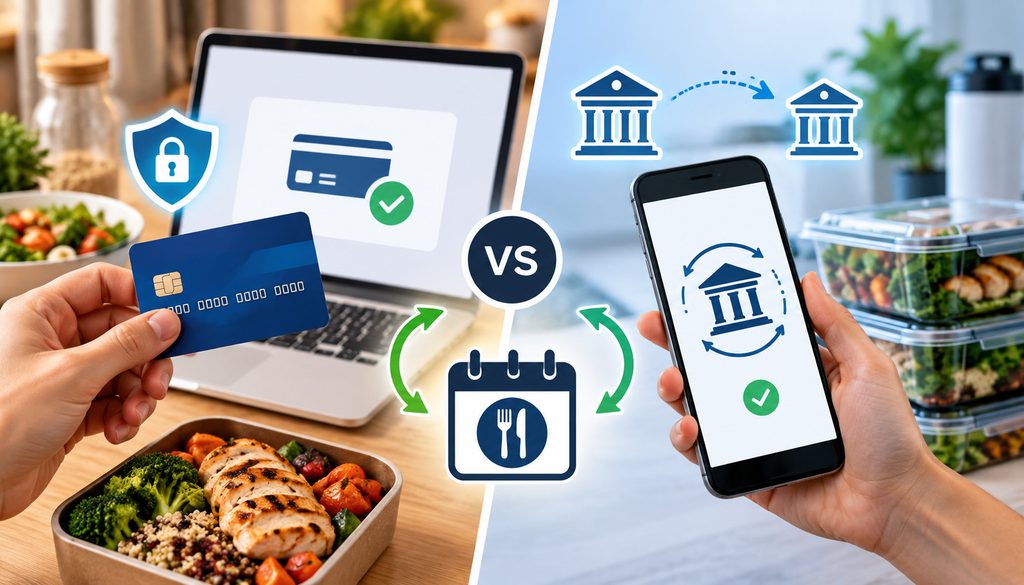
Card and ACH can both work for meal subscriptions, but their economics and operational risks differ.
Card on File
Cards are often convenient for weekly meal plans because authorization feedback is typically available quickly and consumers already understand card checkout.
Potential advantages include:
- fast authorization response,
- mature recurring-payment infrastructure,
- broad customer familiarity,
- tokenization,
- network account-updater capabilities,
- and relatively easy payment-method replacement.
Visa describes account-updater and token-lifecycle services designed to keep eligible stored credentials current when underlying account details change. Support depends on the processor, acquirer, network, tokenization setup, and card account.
Do not store raw payment credentials unnecessarily. PCI DSS applies to environments that store, process, or transmit cardholder data or can affect the cardholder-data environment. The PCI Security Standards Council currently lists PCI DSS v4.0.1 as the published PCI DSS version.
See the PCI Security Standards Council’s PCI DSS resources for current security guidance.
A hosted/tokenized payment provider can significantly reduce the need for a meal-prep application to handle sensitive primary account data directly, although a merchant’s exact PCI obligations depend on its implementation.
ACH for Weekly Meal Subscriptions
ACH can be worth offering to established recurring customers, particularly where transaction economics and customer behavior support it.
Potential benefits include:
- different fee economics from cards,
- suitability for repeat bank-account payments,
- fewer card-expiration issues,
- and usefulness for customers who prefer bank payment.
But ACH should not be marketed internally as “guaranteed money.”
ACH has return and authorization risk. A debit can be returned, and the operational timeline differs from an immediate card authorization.
Nacha states that recurring consumer ACH debit authorization must be in writing or similarly authenticated, contain clear terms, and explain how authorization for future transactions can be revoked.
Nacha’s developer guidance also states that consumer changes in debit amount generally require 10 calendar days’ notice and changes in debit date generally require seven calendar days’ notice, subject to the Rules and applicable authorization structure.
For consumer WEB debits, Nacha also requires account-number validation before first use and after account-number changes as part of a commercially reasonable fraud-detection system.
Operators should review current Nacha ACH authorization guidance with their ODFI/payment provider.
Table 4: Card vs. ACH for Weekly Meal Subscriptions
| Payment Method | Cost Model | Failure/Return Risk | Best Fit |
| Card on file | Often percentage + fixed component | Immediate declines; later disputes also possible | New customers, fast confirmation |
| ACH | May be flat, percentage, capped, or blended | Returns may occur after initiation/settlement | Repeat customers comfortable with bank debit |
| Either | Provider-specific | Requires operational controls | Offer based on economics and workflow |
Illustrative Fee Math at Meal-Prep Ticket Sizes
The following figures are examples only. They are not quoted rates, industry averages, or recommendations.
Assume for illustration:
- Card: 2.9% + $0.30
- ACH: 0.8%, capped at $5.00
| Weekly Charge | Card Cost Example | ACH Cost Example | Key Tradeoff |
| $60 | $2.04 | $0.48 | ACH cheaper in example; card provides fast authorization |
| $100 | $3.20 | $0.80 | Fee gap widens |
| $150 | $4.65 | $1.20 | Recovery/return economics matter |
| $200 | $6.10 | $1.60 | Compare total risk, not fee alone |
The arithmetic should not drive the decision by itself.
A $1.60 ACH payment that later returns after the food has been delivered can be more expensive than a $6.10 card transaction that was confirmed before production.
Total payment economics include:
- successful authorization/collection rate,
- return or dispute risk,
- settlement timing,
- customer adoption,
- support workload,
- recovery expense,
- and waste exposure.
No universal ACH or card failure percentage should be assumed.
A conditional framework is usually better:
New subscriber → card may be simplest.
Long-term repeat subscriber → ACH may be worth offering.
Last-minute signup near production lock → card may provide faster payment confirmation.
Handling Variable Weekly Charges, Proration, and Price Changes
Meal subscriptions frequently do not charge exactly the same amount every week.
A subscriber might have:
- a $90 base plan,
- two premium-meal upgrades,
- an extra breakfast pack,
- a delivery surcharge,
- a loyalty credit,
- or a temporary promotional adjustment.
The billing system therefore needs to distinguish “recurring relationship” from “identical recurring amount.”
Table 5: Variable Charge Scenarios
| Scenario | Possible Billing Treatment | Consent/Notice Check |
| Customer adds meals before cutoff | Include in weekly charge | Was variable basket method disclosed? |
| Premium meal selected | Add premium amount | Is pricing visible before selection? |
| Mid-cycle upgrade | Immediate adjustment or next cycle | Does authorization/terms support it? |
| Meal removed before cutoff | Reduce upcoming charge | Recalculate before billing |
| Service credit | Reduce current/next balance | Maintain credit ledger |
| Plan-wide price increase | New recurring amount | Review notice, law and network rules |
| Late add-on after charge | Supplemental charge/next cycle/decline add-on | Follow disclosed policy |
Proration and Adjustments
Proration becomes relevant when a customer changes service after a billing period has begun.
Examples include:
- joining after the normal menu-open date,
- increasing from six to ten meals,
- reducing a plan,
- adding items after the primary charge,
- receiving a customer-service credit.
A business can choose among several operational models:
Immediate adjustment. Charge or refund the difference promptly.
Next-cycle adjustment. Carry the difference into the following week’s amount.
Account credit. Add the value to an internal credit ledger.
The right approach depends on customer expectations, accounting controls, payment authorization, system capabilities, applicable law, and card/ACH requirements.
Whatever method is selected, the invoice/order record should show how the amount was calculated.
Variable Weekly Basket Amounts
A well-designed signup experience can explain that the amount varies based on customer choices.
For example:
“Your weekly charge equals the base six-meal plan plus any premium meals, add-ons, delivery charges, applicable taxes, and other selections you approve before the weekly cutoff.”
That is operationally better than presenting a “$90 weekly subscription” and then unexpectedly charging $126 without explaining the pricing mechanism.
For card payments, Visa’s stored-credential framework expressly contemplates disclosure of the transaction amount or how it will be calculated.
Mastercard also distinguishes recurring models including fixed-amount subscriptions and variable-amount standing-order arrangements in its transaction-processing framework. Your processor/acquirer should determine the correct transaction treatment for your particular payment model.
Menu Price Changes
A change in the underlying plan price requires more care than a customer voluntarily adding an item at the displayed price.
Before making a price change, consider:
- the existing customer agreement,
- how the new price will be disclosed,
- the effective date,
- any applicable state automatic-renewal law,
- card-network requirements,
- ACH notice rules,
- and whether new affirmative consent is required under the circumstances.
Do not assume that “the customer stays subscribed” always means any new recurring price is automatically authorized.
For ACH consumer debits specifically, Nacha’s guidance describes advance notice requirements for changes in debit amounts unless an applicable authorization structure or Rules provision addresses the variation.
For card payments, consult current Visa/Mastercard rules and your acquirer rather than treating a generic subscription clause as unlimited authority to change amounts.
How to Change Prices Without Re-Collecting Consent Every Week
The objective is not to obtain a new subscription contract every Monday.
A recurring authorization can be structured around variable weekly billing when the calculation method is properly disclosed and transactions are processed in accordance with applicable rules.
For example, a subscription could authorize:
- a defined base plan,
- customer-selected meal quantities,
- disclosed add-on prices,
- and other variable components selected by the customer.
That allows the customer’s deliberate weekly basket changes to flow into the charge without pretending every amount was fixed in advance.
A business-wide price increase is different. Provide whatever notice and consent treatment is required by applicable law, network rules, ACH rules, processor requirements, and the original agreement.
Credits vs. Refunds
Credits and refunds should have different accounting states.
A credit stays on the customer’s account for future use.
A refund sends previously collected money back through the appropriate payment process.
An account-credit ledger might show:
**Opening credit
- service credits issued
− credits applied
= remaining available credit**
Credits may be appropriate for promotions or voluntarily accepted service remedies, but they should not be used to sidestep an obligation to provide a refund where a refund is required.
Cloud Food Manager’s guide to automating food-cost reporting and analysis is useful background for operators trying to connect pricing and cost movements to better financial controls.
How Meal Prep Software Should Model Billing and Production States
A single active/inactive field is not enough.
A meal-prep system should separately model at least:
Subscription state
- active
- paused
- canceled
Week/order state
- open
- skipped
- locked
- payment pending
- payment failed
- paid
- production released
- fulfilled
- canceled/removed
The distinction allows combinations such as:
Subscription = active
Order = skipped
or:
Subscription = active
Order = payment failed
or:
Subscription = paused
No order generated
Order State vs. Subscription State
This is one of the most important architecture decisions in the entire meal prep subscription billing setup.
Suppose Ava’s Thursday charge fails.
If software changes Ava’s customer subscription to inactive, it may:
- remove next week’s menu access,
- stop future billing,
- erase her recurring preferences,
- trigger cancellation reporting,
- and classify an involuntary payment problem as voluntary churn.
Instead:
Ava subscription: Active
September 13 order: Payment failed — production removed
September 20 order: Eligible to generate normally
The next cycle gets another opportunity unless Ava cancels, pauses, or the business’s documented policy requires another state.
Billing Calendar Configuration
A practical subscription configuration should store:
- delivery weekday/date,
- menu-open time,
- order-edit cutoff,
- skip/pause cutoff,
- billing run time,
- payment-recovery window,
- production lock,
- fulfillment date.
An illustrative configuration might look like this:
| Event | Example Time | System Action |
| Menu opens | Monday | Customer edits |
| Skip cutoff | Wednesday | Lock preferences |
| Billing run | Thursday | Charge eligible orders |
| Retry deadline | Friday | Resolve failures |
| Production lock | Friday | Release paid orders |
| Delivery | Sunday | Fulfill |
Again, these dates are examples only.
Customer Notifications
A useful notification framework can include:
- menu-open reminder,
- skip-deadline reminder,
- charge confirmation,
- failed-payment notice,
- payment-recovery confirmation,
- order-removal notice,
- pause-resume reminder.
Avoid generating so many notices that customers stop reading the important ones.
Customer Self-Service Portal
At minimum, customers should be able to understand:
- current plan,
- current week’s selections,
- next charge date,
- next delivery date,
- current payment method,
- account-credit balance,
- skip status,
- pause status,
- cancellation status.
Where applicable, provide clear controls for:
Skip this week
Pause deliveries
Cancel subscription
Those actions should not be visually or operationally interchangeable.
Prevent Duplicate Charges After Resume
Duplicate prevention should be built around an invariant:
One successfully billable order per subscription per service week.
If a first attempt succeeds but the response reaches the billing application slowly, the application should not create another order merely because it did not immediately display success.
Likewise:
- resuming twice should not create two orders,
- a retry should reference the same unpaid order,
- production should not receive two tickets,
- and a late webhook should not overwrite an already settled state incorrectly.
This is where idempotent billing behavior matters operationally even without discussing programming details.
Late Menu Add-Ons
A customer may want an extra snack pack after Thursday’s main billing run.
The business needs one consistent rule.
Options include:
- run a supplemental approved charge,
- place the add-on on the next billing cycle,
- or stop accepting billable add-ons after cutoff.
If production inventory is already locked, the correct answer may simply be that the add-on is unavailable.
Reports That Catch Involuntary Churn Early
Meal prep churn billing should separate voluntary cancellation from payment-driven revenue loss.
A useful reporting system distinguishes at least:
Voluntary churn: Customer intentionally cancels.
Involuntary churn: Subscription effectively ends because payment cannot be collected.
Skip: Customer suppresses one cycle but remains active.
Pause: Customer intentionally suspends multiple cycles but may return.
Those are not interchangeable metrics.
Table 6: Subscription Billing Metrics
| Metric | Formula/Definition | What It Reveals |
| Initial decline rate | Failed first attempts ÷ scheduled charges | First-pass payment friction |
| First-attempt approval rate | Successful first attempts ÷ scheduled charges | Initial collection performance |
| Recovered payment ratio | Failed charges recovered before production cutoff ÷ total failed charges | Dunning effectiveness |
| Unresolved payment rate | Failures unrecovered by production lock ÷ scheduled charges | Lost weekly orders |
| Skip frequency | Skipped cycles ÷ eligible subscription cycles | Usage flexibility |
| Pause count/rate | Paused subscribers or events | Temporarily suppressed demand |
| Involuntary churn | Customers lost following unresolved payment problems | Payment-driven attrition |
Weekly Decline Rate
Track the charge waterfall:
Scheduled charges
→ successful first attempts
→ failed first attempts
→ recovered failures
→ unresolved failures.
The analytical formula is:
Initial decline rate = failed first attempts ÷ scheduled charges
Example:
If 1,000 weekly charges were scheduled and 70 failed initially:
70 ÷ 1,000 = 7% initial decline rate
That is an example calculation, not a benchmark suggesting 7% is good or bad.
Track the metric consistently so operational changes can be evaluated against the business’s own history.
Recovered Payment Ratio
Use:
Recovered payment ratio = failed charges recovered before production cutoff ÷ total failed charges
Suppose 70 charges initially fail and 42 are recovered before production locks.
42 ÷ 70 = 60%
Again, that is illustrative math, not an industry target.
The timing qualifier matters. A payment collected three days after the customer’s meals were removed from production does not represent the same operational recovery as a payment collected while the order could still be fulfilled.
Skip and Pause Frequency
Useful skip reporting may include:
- average skips per subscriber,
- percentage of eligible subscribers skipping each service week,
- consecutive skipped weeks,
- skip-to-resume behavior,
- skip-to-cancel conversion.
Frequent skips do not necessarily indicate churn. Vacation, travel, holidays, menu preferences, and schedule changes can all create legitimate skip behavior.
Similarly, a pause may preserve future revenue that would otherwise be lost through cancellation.
Track pauses separately:
Active → Pause → Resume
rather than:
Active → Churn → New customer
That gives a more accurate retention picture.
Failed Payments That Become Churn
Track the complete chain:
Payment fails
→ current order removed
→ next eligible cycle also fails
→ no payment method update
→ account eventually canceled or becomes inactive.
This group represents payment-driven attrition that might otherwise disappear inside a generic cancellation figure.
Cohort Analysis
A modest amount of cohort reporting can reveal whether payment problems occur disproportionately among:
- newly acquired subscribers,
- customers around 30 days old,
- long-term subscribers,
- particular plan types,
- card versus ACH users.
Do not turn this into a giant analytics project. The point is to identify where failures and skips cluster.
Recommended Billing Dashboard
A weekly operator dashboard could show:
- active subscriptions,
- scheduled weekly charges,
- first-attempt approval rate,
- initial decline rate,
- recovered payment ratio,
- unresolved failed payments,
- current-week skips,
- paused subscribers,
- cancellations,
- involuntary churn,
- paid orders released to production.
Common Meal Prep Subscription Billing Mistakes
Meal-prep billing failures usually happen where subscription logic meets operational timing.
Table 7: Common Mistakes
| Mistake | Operational Risk | Better Approach |
| Billing before skip deadline | Refunds, disputes, frustration | Bill after selections lock |
| Billing too close to production | No recovery window | Allow recovery before kitchen commitment |
| Charging a skipped week | Trust/dispute risk | Suppress order and charge |
| Treating pause as cancellation | Lost customer state | Maintain separate pause state |
| Retrying after production closes | Payment with no fulfillable order | End week-level recovery at production lock |
| No failed-payment deadline | Ambiguous kitchen decisions | Define recovery cutoff |
| One generic “inactive” state | Accidental churn | Separate subscription/order/payment states |
| Hiding cancellation | Consumer-protection risk | Provide accessible cancellation |
| Unclear price changes | Billing disputes | Give appropriate disclosure/notice |
| Counting skips as churn | Bad retention reporting | Report skips separately |
| Weak billing-production reconciliation | Duplicate/missing orders | Reconcile paid orders to kitchen release |
Another mistake is allowing billing and production teams to work from different versions of the truth.
Finance may believe a retry succeeded. The kitchen may still see the order as canceled. Customer service may believe the customer skipped. The delivery team may already have the address on its route.
Use one authoritative order record and explicit state transitions.
Practical Meal Prep Billing Workflow
A workable implementation sequence is:
- Set the delivery calendar: Define service dates and operational lead times.
- Define the weekly menu-selection cutoff: Establish when customer choices become final.
- Set the skip and pause cutoff: Make the customer’s modification deadline clear.
- Schedule billing after applicable selections lock: Do not charge an order that is still legitimately editable under the stated policy.
- Leave enough time for payment recovery: Work backward from ingredient purchasing and production commitment.
- Create distinct paid, payment-pending, and failed states.
- Suppress skipped and paused cycles before billing.
- Run eligible weekly charges.
- Notify customers promptly when payment fails.
- Retry only within a processor/network-compliant and operationally useful recovery window.
- Remove unresolved orders before production becomes irreversible.
- Release successfully paid orders to kitchen production.
- Fulfill and deliver orders.
- Preserve the underlying subscription state for the next week where appropriate.
- Track initial decline rate.
- Track payments recovered before production lock.
- Track skip and pause frequency separately.
- Monitor payment failures that become involuntary churn.
- Periodically review cancellation, recurring-payment, ACH, network, and customer-disclosure requirements.
The result should be a weekly closed loop:
Menu → cutoff → billing → payment recovery → production release → fulfillment → reconciliation → next cycle.
Meal Prep Subscription Billing Checklist
Before going live, confirm that the system can support the following:
- Define weekly delivery schedule.
- Set menu-selection cutoff.
- Set skip/pause deadline.
- Schedule billing after applicable selections lock.
- Leave payment-recovery time before production.
- Store clear subscription states.
- Store separate order/payment states.
- Suppress billing for skipped weeks.
- Suppress billing while paused.
- Preserve the subscription after a one-week skip.
- Show customers the next charge date.
- Show customers the next delivery date.
- Capture recurring-payment consent appropriately.
- Retain the applicable version of recurring terms.
- Use secure/tokenized card-storage architecture.
- Follow current stored-credential transaction requirements.
- Use appropriate ACH authorization controls when ACH is offered.
- Provide a reasonably accessible cancellation path.
- Notify customers after failed payments.
- Give customers a secure payment-update route.
- Retry only within an appropriate permitted recovery window.
- Stop the current week’s dunning when fulfillment is no longer possible.
- Remove unresolved orders before production lock.
- Preserve future subscription eligibility when appropriate.
- Prevent duplicate weekly orders and charges.
- Reconcile successful payments to production orders.
- Track first-attempt decline rate.
- Track recovered payment ratio.
- Track unresolved payment failures.
- Track skips separately from churn.
- Track pauses separately from cancellations.
- Track involuntary churn.
- Review recurring billing and cancellation disclosures regularly.
Frequently Asked Questions
How should meal prep subscription billing work?
A meal subscription should follow the kitchen’s weekly operating calendar: menu availability, customer-change cutoff, billing run, payment recovery, production lock, and delivery. The payment system should release only eligible paid orders into production.
When should a weekly meal prep subscription charge the customer?
There is no universal day. Charge early enough to address payment failures before ingredients, labor, and fulfillment become difficult to reverse, while respecting the customer’s stated menu-edit and skip period.
Should billing happen before or after the order cutoff?
For many models, billing after the applicable order/skip cutoff prevents charging customers while permitted changes are still available. The business must still leave sufficient time between billing and production for failed-payment recovery.
How should a one-week skip work?
A valid skip should suppress that week’s order and charge while keeping the subscription active for the following eligible week.
What is the difference between pause and cancel?
A pause temporarily suspends future orders and charges with an expectation that service can resume. Cancellation ends the ongoing subscription relationship.
Can a paused subscription resume automatically?
It can if the system and customer arrangement support a scheduled resume date. The customer should be able to understand when billing and delivery will restart, and applicable legal/payment requirements still apply.
Does a skipped week still get charged?
A properly processed pre-cutoff skip should not generate the ordinary subscription charge for that skipped order.
What happens when a weekly meal-prep charge fails?
The current order should normally move to a payment-pending state, the customer should be notified, and permitted recovery activity can occur before the production deadline. If payment remains unresolved when production locks, the current order can be removed according to the disclosed policy.
How many times should a failed payment be retried?
There is no safe universal number. Retry decisions should account for issuer/processor guidance, card-network requirements, decline information, customer communication, and the time remaining before production.
When should an unpaid meal order be removed from production?
Remove or hold it before ingredient, labor, packaging, or delivery commitments become materially irreversible. Each operation should define that deadline based on its production process.
Is card or ACH better for weekly meal subscriptions?
Neither is universally better. Cards usually provide faster authorization feedback and broad customer familiarity. ACH may have attractive economics for repeat customers but introduces a different settlement and return profile.
How should variable weekly meal charges be authorized?
The enrollment experience should clearly explain that the amount can vary and how it is calculated—for example, base plan plus customer-selected add-ons and premium meals. Payment-method-specific notice and authorization requirements should also be followed.
Can a meal-prep company increase subscription prices without getting new consent every week?
Weekly re-authorization is not necessarily required merely because a disclosed basket varies, but operators should not assume they can change recurring plan pricing without limitation. Applicable law, customer terms, ACH rules, network requirements, and required notices or renewed consent should be reviewed.
What is involuntary churn in meal-prep subscriptions?
It is customer loss caused by payment collection problems rather than an intentional customer cancellation. Track it separately from voluntary cancellations, skips, and pauses.
Which billing reports should a meal-prep business track?
Useful reports include active subscriptions, scheduled charges, first-attempt approval and decline rates, recovered payment ratio, unresolved failures, skips, pauses, cancellations, involuntary churn, and paid orders released to production.
Conclusion
Meal-prep recurring billing succeeds when payments follow the kitchen calendar rather than operating as an isolated subscription process.
The order cutoff determines when customer choices become actionable demand. Billing should occur with enough time left to resolve payment failures before food, labor, packaging, and routing costs become difficult to reverse.
Skips should suppress one week’s charge and production order without canceling the customer. Pauses should preserve the relationship and resume predictably.
Failed-payment recovery should also have a firm operational endpoint. If payment remains unresolved when the kitchen must commit, the current order should be held or removed according to the business’s disclosed policy while the underlying subscription can remain available for future cycles when appropriate.
Card and ACH payments bring different cost, authorization, settlement, return, and customer-experience considerations. Variable pricing and proration require transparent calculation and careful notice practices.
Ultimately, the most reliable meal prep subscription billing setup is a synchronized loop: menu → cutoff → charge → recovery → production → delivery → reconciliation → next week. When those systems share the same states and deadlines, operators gain better control over waste, collections, customer experience, and involuntary churn.