
JIT in a kitchen means timing each perishable delivery close to when you’ll cook it, sized to measured usage and supplier lead time, not walk-in capacity.
What JIT Inventory Management Looks Like on a Restaurant Line
A kitchen has a harsher version of the same problem. Product doesn’t go obsolete, it goes soft, gray and out of code, and the cash you spent on it sits in a cooler earning nothing until it either sells or goes in the trash. Every extra case of romaine is a bet that demand shows up before the leaves do.
What jit inventory management is not, in a restaurant, is zero stock. It’s a par level for every item you order, the quantity you want on hand at the start of each order cycle. You set it from usage rate multiplied by lead time, the gap between placing the order and the truck actually arriving, then add safety stock on top for anything that would force you to 86 a dish, meaning pull it off the menu because you’re out. Say you go through eight pounds of shrimp a day and your supplier delivers 48 hours after cut-off. Sixteen pounds covers the cycle. Whether you carry four more pounds depends on how often that supplier short-ships you.
Split the item list by risk before you touch a single par. Herbs, leaf produce, dairy and fresh protein reward short cycles. Flour, canned tomato, frozen fries, to-go containers and gloves do not, and chasing three deliveries a week on packaging just buys you more receiving labor.
The demand signal comes from your POS. Recipe-level sales data gives you theoretical usage, the amount you should have consumed given what you sold, which is what makes a par defensible instead of a chef’s hunch. That’s the whole argument for Integrating Food Cost Tracking with POS Systems, and if you’re still counting on a clipboard, start with What Is Food Cost Tracking Software and How Does It Work?
One caveat for operators running a commissary or packing food for wholesale: ordering tighter changes nothing about your written obligations. Where 21 CFR Part 117 applies, hazards requiring a preventive control still need controls identified and documented in advance, not decided on the fly at the receiving door (21 CFR 117.135 — Preventive controls).
Setting Par Levels and Safety Stock You Can Defend
The arithmetic is one line: average daily usage times lead time in days, plus safety stock. Size the safety stock by consequence. A menu-critical item that stops tickets when it’s gone gets a full delivery cycle of cover; a garnish that a server can talk around gets none. Then check the answer against shelf life, because usable days after receiving cap the order quantity even when the par says otherwise. Pull the usage numbers from your own sales mix rather than a supplier’s guess, which is the same discipline behind How to Calculate Food Costs with Cloud-Based Tools.
| Item | Usage | Lead time | Safety stock | Par | Reorder point | Order at count | Shelf-life cap |
|---|---|---|---|---|---|---|---|
| Burger patties | 120/day | 2 days | 25% = 60 | 300 | 300 | Par minus on hand; 180 on hand means 120 | Frozen, cap not binding |
| Romaine | 4 cases/day | 1 day | 1 day = 4 cases | 8 cases | 8 cases | 5 on hand means 3 cases | 5 usable days = 20 cases |
| Specialty cheese | 2 lb/week | 7 days | None | 2 lb | 2 lb | 0.5 lb on hand means 1.5 lb | Sealed wheel, 30 days |
Copy the column structure and the patty row stands up to an owner asking why you hold 300. Each figure traces to sales data, a supplier’s delivery schedule, or a date on the case. Catering volume swings harder, so recalculate pars per event rather than per week, as Food Cost Tracking for Catering Businesses (2026 Guide to Better Margins) sets out.
Where JIT Breaks a Kitchen: Date Marking, Rotation and the 41°F Clock
Food safety sets the hard ceiling on how much cover you can hold. CDC treats date marking as a restaurant control point that inspectors and public-health programs actively watch, not as optional back-office paperwork. (Date Marking and Restaurant Practices)
That rule changes how far your pars can stretch. The full seven-day window exists only at 41°F or below. (FDA Food Code Section 3-501.17) If a deli cooler lives on the edge, your usable window shrinks before you ever get to the cost discussion, so your safe order size shrinks with it. That is where jit inventory management hits a kitchen wall: not in theory, in a warm rail during Friday service.
Case dates don’t fix this for you. (Food Product Dating) Your rotation rule should be simpler: received-date labels on every case, prep or open dates on every ready-to-eat item, oldest product moved forward first, no exceptions at receiving. If you need the storage logic in one place, see FIFO vs. LIFO in Food Storage: What’s Best for Restaurants? (2026 Operations Guide).
Federally funded food programs make that standard explicit. USDA Foods inventory must be stored under FIFO and backed by inventory records. (7 CFR 247.28 — Storage and inventory of USDA Foods) That’s a solid SOP for any kitchen. A labeling workflow tied to cooler checks, like the approach in How Cloud Tools Simplify Food Safety Compliance, lets you see both clocks at once: which pan expires first and which cooler is quietly cutting your allowed holding time.
Rolling It Out Without a Stockout in Week One
Pick a slow month, not December. You want two weeks where a par set too low costs you one 86 instead of a Saturday night, and where a manager has time to count at close without cutting labor somewhere else.
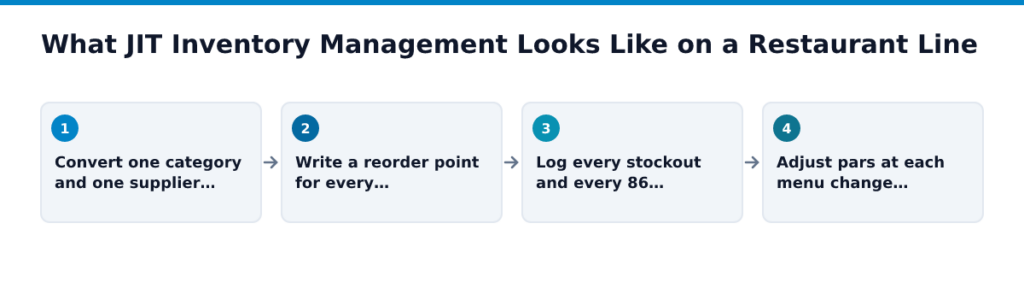
- Convert one category and one supplier first. Produce, almost always, because the shelf life punishes over-ordering fastest.
- Write a reorder point for every item in that category and print it on the shelf tag. A par that lives in the sous chef’s head disappears on their day off.
- Log every stockout and every 86 next to your food cost percentage. Optimize one number alone and you’ll wreck the other.
- Adjust pars at each menu change and each seasonal swing.
Done looks like this: Getting there is mostly counting discipline, which is easier when the counts live in software rather than a clipboard, as we cover in How to Set Up a Cloud-Based Food Inventory System and How to Implement Food Service Management Software. Watch the usage math too, since the errors in Top Food Cost Tracking Mistakes Restaurants Make will corrupt every par you set.
The Supplier Terms That Decide Whether This Works
Three vendor terms set your minimum safety stock: how often the truck comes, when the order has to be in, and how wide the promised delivery window is. A four-hour window on a Tuesday morning is a different kitchen than “sometime Tuesday.” Get all three in writing before you shorten a single order cycle.
Then ask for fill rate and the substitution policy. Watch minimum order values and split-case fees too, because ordering three times a week instead of once can cost more in delivery minimums and case-breaking charges than you save in carrying cost and spoilage. That math is one of the Common Food Service Management Challenges that quietly reverses a good idea.
Ask what happens the week of a holiday, and get the modified cut-off in email.
Call your rep this week and ask for those terms line by line. Log the answers next to each item’s par in whichever of the Essential Food Service Management Tools you already use.
Frequently Asked Questions
What is EOQ and how does it differ from JIT?
JIT moves in the opposite direction: it accepts more frequent ordering work in exchange for less cash and less shelf space tied up in product. For a kitchen, the honest split is by shelf life, since EOQ logic works on canned tomatoes and cocktail napkins, while anything on a seven-day date-marking clock is a JIT item whether you want it to be or not (FDA Food Code Section 3-501.17).
Can EOQ and JIT run side by side in one kitchen?
Yes, and most well-run kitchens already do it without naming it. Split your item list into shelf-stable and perishable, buy the shelf-stable side on delivery minimums and case-break pricing, and buy the perishable side to a par level you reset every week. The mistake we see is applying one ordering rhythm to the whole sheet, which either buries you in produce or leaves you paying for extra dry-goods drops you didn’t need.
Does JIT make my food cost percentage go down?
Not directly. JIT reduces waste and spoilage, which shows up as fewer units thrown away rather than a lower price per unit, so your cost per plate improves while your invoice price stays where your supplier set it. If you want the purchase price to move, that’s a volume and contract conversation, and buying smaller quantities more often can work against you there.
How do I know whether a stockout was a par level problem or a supplier problem?
Log the cause on the day it happens, in two categories: you ordered too little, or the order arrived short, late, or rejected at the door. Only the first is a par level you can fix on your own. If the second category keeps filling up with the same item, the answer is a second approved source for that item, not a bigger walk-in order.