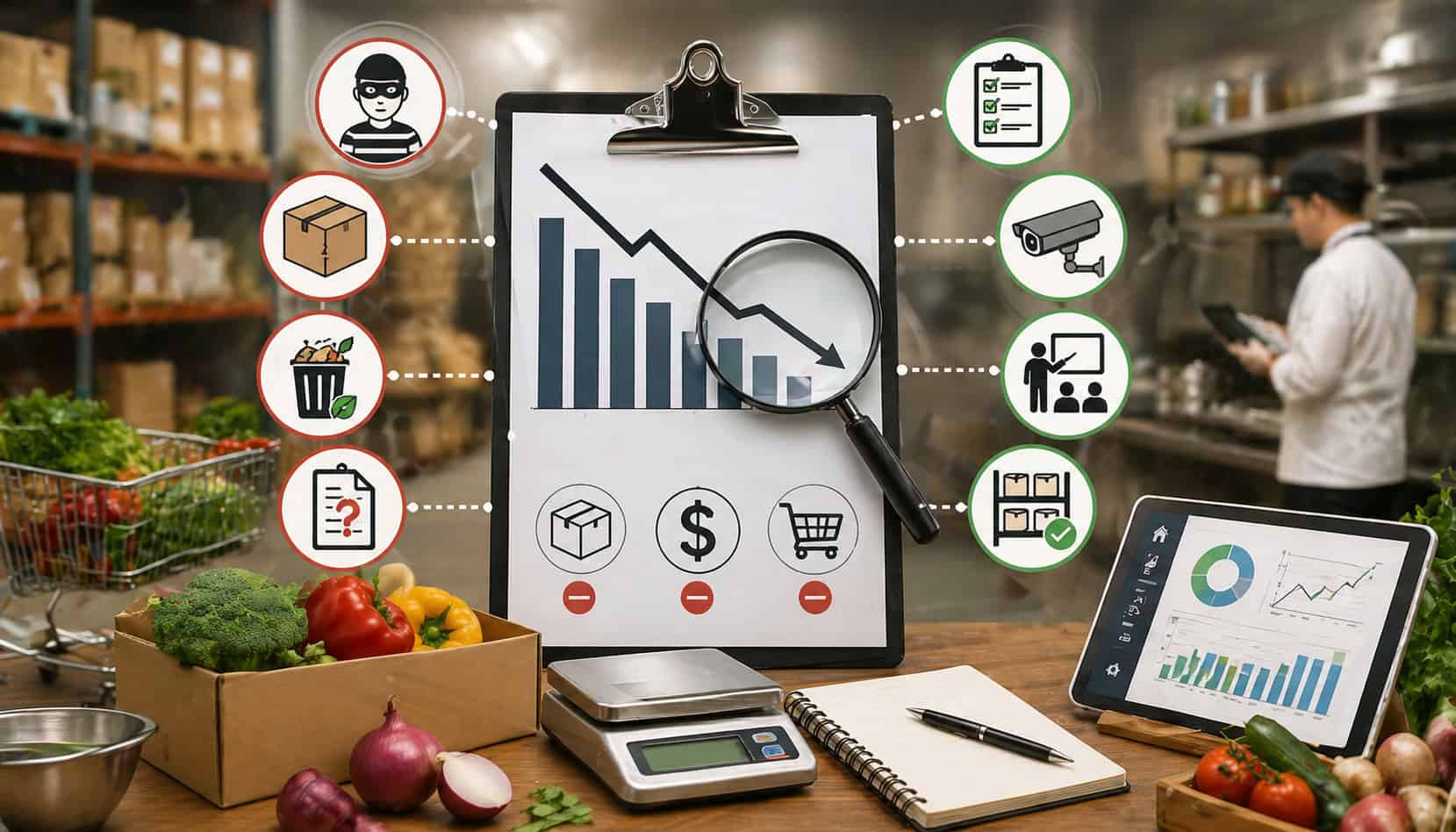
Inventory shrinkage is one of the most frustrating profit leaks in food service because it often hides in daily routines. A few missing steaks, a case of produce that spoils early, unrecorded staff meals, short supplier deliveries, incorrect prep yields, or rushed stock counts may not seem serious on their own.
But over time, these small gaps can quietly increase food costs, distort purchasing decisions, and make kitchen planning harder than it needs to be.
For restaurants, catering businesses, cafés, hotels, commissary kitchens, and food service operators, shrinkage is not only a financial issue. It affects menu availability, customer experience, staff accountability, supplier trust, and operational consistency.
When recorded stock does not match what is actually available, managers may over-order, under-order, miss prep deadlines, or make menu decisions using unreliable data.
Understanding inventory shrinkage causes and prevention helps food service teams move from guesswork to control. The goal is not to blame staff or chase every small discrepancy with frustration. The goal is to build a system where receiving, storage, prep, waste tracking, counting, and reporting all work together.
What Is Inventory Shrinkage?
The inventory shrinkage meaning is the difference between what your records say you should have and what you physically have on hand. In food service, this difference can happen with ingredients, packaged goods, beverages, disposables, cleaning supplies, and high-value items such as meat, seafood, alcohol, or specialty products.
For example, your inventory system may show that you should have 20 kilograms of chicken breast, but a physical count shows only 16 kilograms. That missing 4 kilograms is shrinkage unless there is a valid recorded reason, such as prep usage, spoilage, waste, transfer, staff meal, comp, or adjustment.
Shrinkage in inventory management usually appears as:
- Missing ingredients
- Unexplained stock gaps
- Spoiled or expired products
- Incorrect physical counts
- Unrecorded prep usage
- Supplier shortages
- Damaged deliveries
- Unauthorized staff use
- Spreadsheet or software entry errors
In restaurants and kitchens, shrinkage is harder to detect than in many other businesses because ingredients change form. Tomatoes become sauce, flour becomes dough, trim becomes waste, and proteins lose weight during cooking. Without strong inventory control, these normal transformations can hide real loss.
Why Inventory Shrinkage Is a Serious Problem in Food Service

Inventory shrinkage directly affects profit margins because every missing, spoiled, or unrecorded item has already been paid for. If the business cannot sell that product or account for its use, the cost remains while revenue disappears. This is especially damaging for high-cost or high-volume ingredients.
A small variance may look harmless during one count. But when it repeats across multiple ingredients, shifts, stations, or locations, it can raise food cost percentages and make menu pricing less reliable. Managers may believe a dish is profitable when the true ingredient loss tells a different story.
Shrinkage also affects purchasing accuracy. If stock records are wrong, managers may order too much of one item and too little of another. This leads to overstocking, emergency buying, stockouts, supplier rush orders, and unnecessary waste.
Customer experience can suffer as well. If the kitchen unexpectedly runs out of a key ingredient, popular menu items may become unavailable. In catering and event food service, poor stock visibility can create last-minute stress and increase the risk of service failures.
Shrinkage also weakens kitchen planning. Prep lists, production schedules, batch sizes, and par levels depend on accurate stock information. When inventory reports are unreliable, chefs and managers are forced to make decisions based on habit instead of evidence.
Common Causes of Inventory Shrinkage

Inventory shrinkage happens for many reasons, and most businesses deal with more than one cause at the same time. In food service, the most common causes include spoilage, theft, receiving errors, supplier mistakes, untracked waste, poor storage, inaccurate counts, inconsistent units, and weak staff procedures.
The challenge is that shrinkage often looks the same on paper regardless of the cause. A missing case of produce could be theft, spoilage, a short delivery, a transfer that was not recorded, a prep error, or a counting mistake. That is why effective inventory audits must look beyond the number and investigate the process behind it.
Here is a practical overview of common causes and prevention strategies:
| Cause | How It Happens | Prevention Strategy |
| Spoilage and expired stock | Poor rotation, overordering, weak labeling, or improper storage | Use FIFO, date labels, expiry checks, and par-level reviews |
| Theft or unauthorized use | Internal theft, unapproved staff meals, giveaways, or poor access control | Limit access, track comps, review variances, and secure high-value items |
| Receiving errors | Short shipments, wrong quantities, damaged goods, or missed invoice checks | Check every delivery against purchase orders and invoices |
| Supplier errors | Incorrect products, missed credits, substitutions, or pricing issues | Reconcile invoices and document delivery discrepancies |
| Manual entry mistakes | Spreadsheet errors, duplicate items, inconsistent units, or rushed counts | Standardize item names, units, and counting procedures |
| Untracked waste | Spoilage, spills, prep errors, overproduction, or discarded food not recorded | Maintain waste logs and review patterns weekly |
| Poor storage organization | Items hidden, misplaced, mislabeled, or stored in the wrong area | Organize shelves by category, label clearly, and assign ownership |
| Inaccurate recipe yields | Prep or cooking loss not reflected in recipes | Update recipe costing and yield assumptions regularly |
Shrinkage in inventory management is best controlled by combining operational discipline with reliable records. One without the other is not enough. A clean storeroom helps, but only if counts and usage are accurate. Software helps, but only if staff record activity consistently.
Spoilage and Expired Stock
Spoilage is one of the most common forms of food inventory shrinkage. It happens when products become unusable before they are sold, served, or prepared. In kitchens, spoilage often results from poor rotation, overordering, missed expiration dates, incorrect storage temperatures, weak labeling, or unclear ownership of walk-in organization.
Perishable items are especially vulnerable. Produce, dairy, seafood, meat, sauces, prepared batches, and ready-to-eat items require disciplined handling. If newer stock is placed in front of older stock, older products may be forgotten until they expire. If labels are missing or unclear, staff may not know what needs to be used first.
Overordering is another major cause. Buying more than the kitchen can realistically use increases the risk that ingredients will age, lose quality, or spoil before service. This often happens when purchasing is based on habit rather than sales trends, par levels, event schedules, and actual usage.
Spoilage control requires daily attention. Teams should use FIFO rotation, clear date labels, regular shelf checks, and storage standards for each product category. Food waste tracking also helps managers see whether spoilage is isolated or part of a recurring pattern.
Theft and Unauthorized Use
Theft and unauthorized use can create serious inventory loss, especially when high-value items are involved. This may include intentional removal of products, unapproved staff meals, excessive snacking, untracked giveaways, unauthorized comps, or using ingredients for personal purposes without recording them.
Internal theft is sensitive, but ignoring it can harm the business and the team. Honest employees are affected when missing stock creates stricter controls, lower trust, or pressure during service. Strong theft prevention should focus on clear rules, limited access, documentation, and accountability rather than suspicion.
Unauthorized use is sometimes caused by unclear policies. Staff may not know whether meals, tastings, mistakes, or leftovers should be recorded. If managers allow informal exceptions, inventory records become unreliable. Over time, these gaps make true food costs harder to understand.
Prevention starts with access control. High-value products should be stored securely, and only authorized staff should handle certain inventory areas. Staff meals, comps, waste, and transfers should be documented. Variance reports can help identify unusual usage patterns without relying on guesswork.
Receiving and Supplier Errors
Receiving is one of the most important control points in restaurant stock management. If deliveries are not checked carefully, inventory records may be wrong before products even reach storage. Short shipments, damaged goods, wrong quantities, poor substitutions, missed credits, incorrect weights, and invoice errors can all create stock discrepancies.
A common mistake is accepting deliveries during a busy period without a proper check. Boxes may be placed in the walk-in quickly, invoices may be signed without review, and damaged or missing items may not be noticed until later. By then, it may be harder to request a credit or prove the issue.
Supplier errors are not always intentional. Picking mistakes, substitutions, pricing updates, and packing issues happen. But if the receiving team does not compare purchase orders, invoices, quantities, quality, temperature, and product condition, those mistakes become the operator’s cost.
Strong receiving procedures help prevent inventory shrinkage from entering the system. Deliveries should be checked before acceptance whenever possible. Any shortages, quality concerns, damaged packaging, or temperature issues should be documented immediately.
Inaccurate Counts and Manual Entry Mistakes
Not every shrinkage problem is a physical loss. Sometimes the issue is inaccurate data. Rushed counts, inconsistent units, duplicate records, spreadsheet formulas, unclear item names, and manual entry mistakes can make inventory reports unreliable.
For example, one manager may count cheese by case, another by kilogram, and another by pack. If the system does not standardize units, the final report may show a variance that is not real. The same issue happens when items are named inconsistently, such as “tomatoes,” “tomato case,” “roma tomato,” and “fresh tomatoes” appearing as separate records.
Manual spreadsheets can work for small operations, but they become risky as inventory grows. Formula errors, accidental overwrites, outdated tabs, and missing entries can create false shrinkage or hide real loss. When reports cannot be trusted, managers lose confidence in the numbers.
Inventory audits should include data-quality checks. Review item names, units, categories, conversions, par levels, and recipe links. Train staff to count the same way every time and schedule counts when employees can focus.
How to Calculate Inventory Shrinkage

To calculate inventory shrinkage, compare expected inventory with actual physical inventory. Expected inventory is what you should have based on beginning stock, purchases, and recorded usage. Actual inventory is what you count during a physical inventory check.
A simple formula is:
Inventory Shrinkage = Expected Inventory – Actual Inventory
You can also calculate shrinkage percentage:
Shrinkage Percentage = Shrinkage Value ÷ Expected Inventory Value × 100
For food service, it is often best to calculate shrinkage by value, not only by quantity. This helps managers focus on the items that have the biggest financial impact.
Example:
- Beginning inventory: 50 units
- Purchases: 30 units
- Recorded usage: 60 units
- Expected ending inventory: 20 units
- Physical count: 16 units
- Shrinkage: 4 units
If each unit costs 12, the shrinkage value is 48. If expected inventory value was 240, the shrinkage percentage is 20%.
A more detailed food service example may include beginning inventory, purchases, recipe usage, waste, transfers, and ending inventory. The more accurately you record these movements, the easier it becomes to separate true shrinkage from normal usage.
For example:
- Beginning chicken inventory: 80 kilograms
- Purchases during the period: 50 kilograms
- Recorded recipe usage: 100 kilograms
- Recorded waste: 5 kilograms
- Expected ending inventory: 25 kilograms
- Physical count: 21 kilograms
- Shrinkage: 4 kilograms
In this case, the missing 4 kilograms should be investigated. Possible causes include unrecorded prep waste, incorrect portioning, staff meals, receiving shortages, theft, or count errors.
Inventory Shrinkage Prevention Strategies
The best way to prevent inventory shrinkage is to build controls into daily operations. Shrinkage prevention should not depend on one monthly count or one manager’s memory. It should be part of receiving, storage, prep, production, waste tracking, transfers, purchasing, and reporting.
Effective inventory shrinkage solutions usually include:
- Strong receiving checks
- Regular cycle counts
- FIFO rotation
- Clear date labeling
- Organized storage areas
- Staff training
- Waste logs
- Transfer documentation
- Access controls
- Recipe yield reviews
- Inventory audits
- Software-based tracking
A practical prevention system starts with visibility. Managers need to know what was ordered, what arrived, where it was stored, how it was used, and what was wasted. When those steps are documented, it becomes easier to identify problems early.
Accountability also matters. Assign inventory owners for key areas such as dry storage, walk-ins, freezers, bar stock, catering supplies, or high-value proteins. When everyone owns everything, no one truly owns the result.
Training is equally important. Staff should understand how shrinkage affects food costs, scheduling, purchasing, menu availability, and daily operations. When employees see inventory control as part of good service, compliance improves.
For more structured setup guidance, a resource on setting up kitchen inventory management can be useful when building a repeatable process.
Improve Receiving Procedures
Receiving is the first opportunity to stop shrinkage before it enters your inventory records. Every delivery should be checked against purchase orders, invoices, quantities, quality, temperature, and product condition before acceptance.
If the invoice says five cases arrived, staff should confirm that five cases are physically present. If products are sold by weight, the weight should be checked. If refrigerated or frozen goods arrive at unsafe temperatures, the issue should be documented and escalated before products are accepted.
Damaged packaging, poor quality, missing items, incorrect substitutions, and price discrepancies should be recorded immediately. When credits are needed, managers should not rely on memory or verbal promises. Documentation protects the business and helps maintain supplier accountability.
Receiving should not be treated as a low-skill task. The person receiving deliveries directly affects food cost accuracy, supplier relationships, and inventory reliability.
Use FIFO and Date Labeling
FIFO means first in, first out. It is one of the simplest and most effective spoilage control methods. The idea is that older stock should be used before newer stock, reducing the chance that products expire unnoticed.
FIFO only works when storage areas are organized. New deliveries should be placed behind older items, not in front of them. Labels should include receiving dates, prep dates, expiration dates, and product names where needed. Prepared foods and opened packages should be especially clear.
Date labeling also supports faster decisions during prep. If staff can quickly see which items need to be used first, they can plan batches, specials, sauces, soups, marinades, or staff meals around products at risk of spoilage.
Poor labeling creates confusion and waste. When employees are unsure whether an item is safe, fresh, or intended for a specific dish, it may be discarded or ignored.
Track Waste and Transfers
Waste tracking is essential because not all missing inventory is mysterious. Some loss is known but unrecorded. This includes spoilage, spills, overproduction, burned items, trimming, dropped products, incorrect orders, staff meals, comps, and expired stock.
If waste is not recorded, inventory reports may show shrinkage without explaining why. Managers may suspect theft or counting errors when the real issue is prep waste, portioning mistakes, or overproduction.
Transfers also need documentation. In multi-location operations, catering departments, commissary kitchens, or businesses with separate bar and kitchen stock, ingredients may move between areas. If transfers are not recorded, one department may show shrinkage while another appears overstocked.
Waste logs should be easy to use. Staff are more likely to record waste when the process is quick and practical. Categories such as spoilage, prep error, customer return, overproduction, spill, and transfer help managers identify patterns.
How Inventory Software Helps Prevent Shrinkage
Kitchen inventory management software helps reduce shrinkage by improving visibility, accuracy, reporting, and accountability. Manual methods can work for very small operations, but as menus, suppliers, staff, and locations grow, spreadsheets often become harder to maintain.
Digital inventory tools can track stock levels, purchases, usage, waste, transfers, recipe costs, supplier history, and variance reports in one system. This makes it easier to spot unusual patterns and respond before losses become larger.
Software also supports standardization. Item names, units, categories, suppliers, par levels, and recipes can be managed consistently. This reduces confusion caused by duplicate items, inconsistent units, and manual entry errors.
User permissions are another important benefit. Not every staff member needs the same level of access. Managers can control who can edit counts, approve adjustments, change recipes, update supplier prices, or view reports.
Inventory software can also support alerts for low stock, overstocking, upcoming expiration, unusual usage, and missing counts. These alerts help teams act sooner instead of discovering problems at month-end.
For operators comparing digital options, this guide on cloud food inventory management offers helpful context on how cloud-based systems support food service inventory control.
Real-Time Inventory Visibility
Real-time inventory visibility helps managers see stock changes closer to when they happen. Instead of waiting for a weekly or monthly count, teams can update inventory as products are received, used, transferred, wasted, or adjusted.
This is valuable because shrinkage becomes harder to investigate as time passes. If a manager notices a variance days or weeks later, staff may not remember what happened. Real-time updates shorten the gap between activity and review.
Live stock information also improves ordering. Managers can make purchasing decisions based on current data rather than assumptions. This reduces overordering, stockouts, emergency purchases, and spoilage risk.
Real-time visibility is especially helpful for high-use ingredients, catering production, multi-station kitchens, and operations with multiple managers. Everyone works from the same information, which reduces confusion.
A useful related resource is this article on how real-time food inventory tracking reduces waste, especially for teams focused on reducing waste through better visibility.
Reports That Identify Loss Patterns
Reports are where inventory data becomes actionable. Shrinkage reports, waste logs, variance reports, purchase history, recipe usage, and supplier records can help managers identify where losses are happening.
For example, variance reports may show that one ingredient is consistently missing after weekend shifts. Waste logs may show repeated spoilage in a specific produce category. Purchase history may reveal that a supplier frequently shorts certain items. Recipe reports may show that actual usage is higher than expected because portion sizes are inconsistent.
Reports also support better conversations. Instead of saying, “We are losing too much food,” managers can say, “Prepared sauce waste increased after batch sizes changed,” or “Chicken variance is highest after catering prep.” Specific data leads to better solutions.
Inventory audits become easier when reports are organized. Managers can compare counts, invoices, purchases, usage, and waste records without searching through scattered spreadsheets or paper notes.
For teams evaluating software features, this overview of best practices for using cloud food inventory software can help connect reporting habits with daily operations.
Best Practices for Reducing Food Inventory Shrinkage
Reducing food inventory shrinkage requires consistent habits. One-time cleanup projects may improve the storeroom temporarily, but shrinkage returns when procedures are not maintained.
Start by assigning clear inventory owners. One person should not carry the entire burden, but every major area should have accountability. Walk-ins, freezers, dry storage, bar stock, disposables, prep areas, and catering supplies should each have assigned oversight.
Secure high-value items. Premium proteins, seafood, alcohol, specialty products, and expensive packaged goods should have controlled access. This does not mean creating a hostile workplace. It means protecting valuable stock with sensible procedures.
Reconcile invoices regularly. Compare purchase orders, delivery notes, invoices, credits, and actual received quantities. Supplier discrepancies should be documented and resolved quickly.
Standardize units and item names. Decide how each item should be counted and recorded. Avoid duplicate entries and vague names. Clear data helps prevent false variances and improves reporting.
Conduct regular cycle counts. Instead of counting everything only once a month, count high-value or high-risk items more often. Frequent smaller counts are often more useful than one large rushed count.
Use surprise checks carefully. Occasional unplanned counts can reveal issues, but they should be professional and process-focused. The goal is to verify controls, not create fear.
Train staff on why inventory matters. When employees understand how waste, spoilage, and stock discrepancies affect operations, they are more likely to follow procedures.
Update par levels. Par levels should reflect actual sales, seasonality, event schedules, supplier lead times, and storage capacity. Outdated pars cause overordering and stockouts.
Common Mistakes to Avoid
One common mistake is relying only on monthly counts. Monthly inventory may help with financial reporting, but it often catches shrinkage too late. By the time a variance appears, the cause may be difficult to identify.
Another mistake is ignoring small losses. A few missing items may not seem important, but repeated small losses can create major food cost problems. High-volume ingredients deserve close attention even when each unit is inexpensive.
Skipping delivery checks is also costly. When staff accept deliveries without verifying quantity, quality, temperature, and condition, supplier errors become internal problems. Receiving should never be treated as a formality.
Failing to record waste creates misleading reports. If spoilage, prep mistakes, spills, staff meals, and comps are not documented, managers cannot separate known waste from unexplained shrinkage.
Allowing too many users to edit inventory can also cause problems. Without permissions, staff may accidentally overwrite counts, change item names, adjust quantities, or alter records without review.
Not investigating variances is another issue. Some managers run reports but do not act on them. A variance report is only useful if it leads to questions, corrections, training, or process changes.
Using inconsistent item names creates confusion. If the same ingredient appears under several names, counts and purchasing records become unreliable. Standardization is a basic but powerful inventory control habit.
FAQs
What does inventory shrinkage mean?
Inventory shrinkage means the difference between recorded inventory and actual available inventory. In food service, this can include missing ingredients, spoiled products, expired stock, short deliveries, unrecorded waste, theft, or counting errors.
What causes inventory shrinkage in restaurants?
Inventory shrinkage in restaurants can be caused by spoilage, theft, supplier errors, receiving mistakes, untracked waste, inaccurate counts, poor storage, overproduction, and inconsistent portioning.
How do you calculate inventory shrinkage?
To calculate inventory shrinkage, compare expected inventory with actual inventory. The basic formula is: Inventory Shrinkage = Expected Inventory – Actual Inventory.
How can food service businesses prevent inventory shrinkage?
Food service businesses can prevent inventory shrinkage by improving receiving checks, using FIFO rotation, labeling products clearly, tracking waste, securing high-value items, conducting regular inventory audits, training staff, and using reliable inventory software.
Is spoilage considered inventory shrinkage?
Yes, spoilage can be considered inventory shrinkage when products become unusable before they are sold, prepared, or served. Spoilage should also be tracked separately in waste logs whenever possible.
Can inventory software reduce shrinkage?
Yes, inventory software can reduce shrinkage by improving stock visibility, standardizing records, tracking waste, monitoring usage, managing supplier data, and identifying variance patterns.
How often should inventory be counted?
High-value and high-risk items should be counted more often than low-risk items. Many food service teams use weekly counts for important ingredients and cycle counts for selected categories throughout the week.
What is the difference between shrinkage and food waste?
Food waste is product that is discarded, spoiled, overproduced, spilled, trimmed, or otherwise not served. Shrinkage is the gap between recorded inventory and actual inventory. Food waste can become part of shrinkage if it is not properly recorded.
Conclusion
Inventory shrinkage causes and prevention come down to visibility, consistency, and accountability. Food service businesses lose inventory through spoilage, theft, supplier errors, weak receiving practices, inaccurate counts, untracked waste, poor storage, and unclear procedures. Left unchecked, these losses raise food costs, reduce profitability, disrupt purchasing, and make kitchen planning harder.
The solution is a practical system: check deliveries carefully, rotate stock with FIFO, label products clearly, record waste, control access to high-value items, standardize units, conduct regular inventory audits, train staff, and use reliable kitchen inventory management software where it adds value.
Reducing shrinkage is not about chasing perfection. It is about building habits that protect margins, improve restaurant stock management, support better prep planning, and give teams confidence in their numbers.
When inventory control becomes part of daily operations, food service businesses can reduce loss, make smarter purchasing decisions, and run smoother, more profitable kitchens.