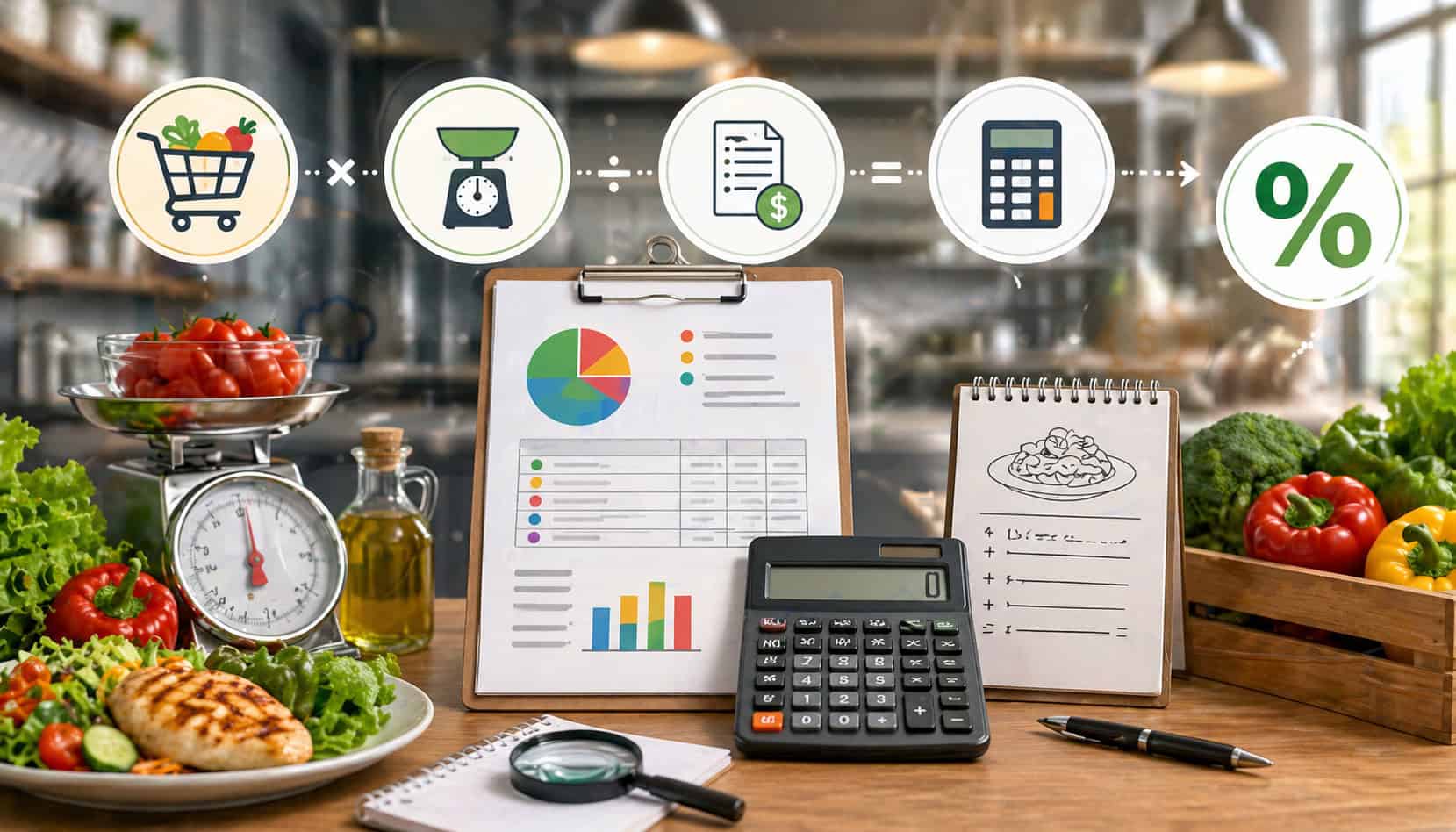
Food cost percentage is one of the most important numbers in food service because it connects kitchen activity directly to profit. It shows whether menu prices, portion sizes, purchasing habits, inventory counts, supplier costs, and waste control are working together or quietly reducing margins.
When you Calculate Food Cost Percentage accurately, you can make better decisions about menu pricing, portion control, supplier negotiations, recipe costing, kitchen inventory management, and overall food cost management. A small error in inventory or sales data can make a profitable menu look weak, or worse, hide a margin problem until it becomes expensive.
This guide explains the food cost percentage formula, the full food cost calculation method, common mistakes, practical control strategies, and how inventory cost tracking supports better restaurant profitability.
What Is Food Cost Percentage?
Food cost percentage measures how much of your food sales are spent on food ingredients. In other words, it shows the relationship between what you paid for food and what you earned from selling that food.
For example, if a kitchen spends $3,000 on food to generate $10,000 in food sales, the food cost percentage is 30%. That means 30 cents of every sales dollar went toward food ingredients before labor, rent, utilities, packaging, and other operating expenses.
This number is useful because it gives operators a clear view of cost performance. A restaurant food cost percentage that is too high may signal over-portioning, waste, theft, outdated menu pricing, supplier price increases, inaccurate inventory counts, or recipes that cost more than expected.
Food cost percentage is not just an accounting metric. Chefs use it to understand recipe profitability. Kitchen managers use it to monitor inventory usage. Owners use it to protect margins. Catering teams use it to compare event profitability against expected food costs.
A strong food cost analysis helps answer questions such as:
- Are menu prices covering ingredient costs?
- Are portions consistent?
- Are supplier prices changing?
- Is inventory being counted correctly?
- Is waste affecting profitability?
- Are high-selling items also profitable?
Why Accurate Food Cost Calculation Matters
Accurate food cost calculation helps food service teams make decisions based on real numbers instead of assumptions. When the numbers are wrong, pricing, purchasing, portioning, and reporting decisions become less reliable.
A common problem is that many operators know their supplier invoices but do not know their actual food usage. Purchases alone do not equal food cost. If you bought $5,000 in ingredients this week, that does not mean you used $5,000 in food.
Some of that product may still be in storage, some may have spoiled, and some may have been used for staff meals, comps, testing, or waste.
That is why accurate inventory cost tracking matters. It connects beginning inventory, purchases, ending inventory, and food sales into one complete food cost calculation method.
Accurate food cost calculation supports:
- Better menu pricing
- Stronger portion control
- Reduced waste and spoilage
- More reliable supplier comparison
- Improved recipe costing
- Better kitchen inventory management
- Stronger restaurant profitability
- Earlier detection of profit leaks
For example, if chicken prices rise but the menu price stays the same, your margin may shrink without anyone noticing. If prep cooks are over-portioning proteins, your theoretical recipe cost may look fine while actual food cost rises. If invoices are missing, the numbers may look better than reality.
Accurate food cost management also creates accountability. Teams can compare expected food cost to actual food cost and investigate the gap. That gap often reveals operational issues such as overproduction, poor receiving procedures, inconsistent recipes, incorrect POS mapping, or weak inventory controls.
Food Cost Percentage Formula Explained
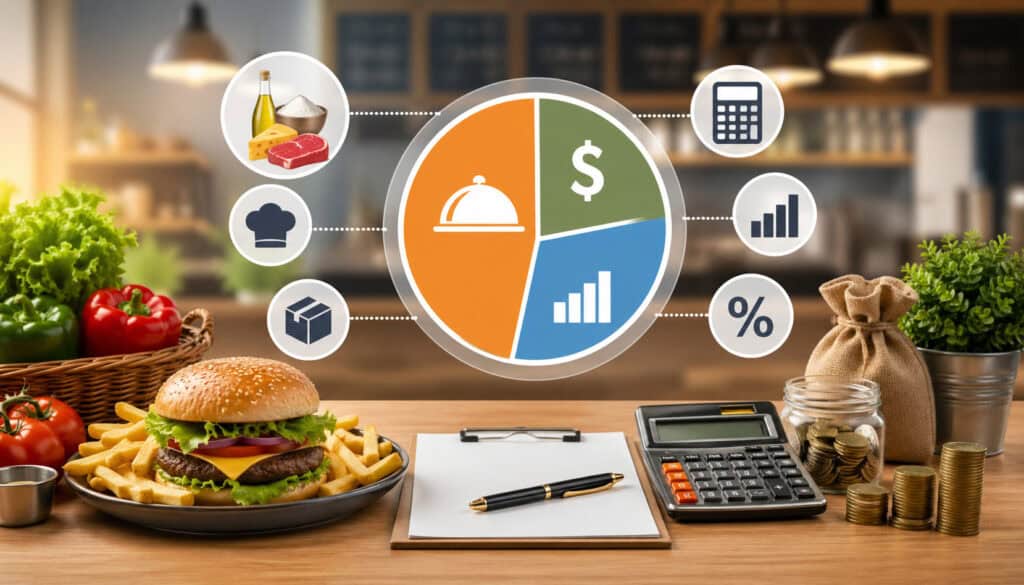
The basic food cost percentage formula is:
Food Cost Percentage = Cost of Food Sold ÷ Food Sales × 100
This formula compares the cost of food used during a period with the food sales generated during that same period. The key is making sure both numbers cover the same reporting period.
To calculate cost of food sold, use:
Cost of Food Sold = Beginning Inventory + Purchases − Ending Inventory
This is also called cost of goods sold, or COGS, when applied to inventory used for sales. In food service, the phrase cost of food sold is often more specific because it focuses on ingredients and food inventory.
Here is a simple breakdown:
| Term | Meaning | Example |
| Beginning Inventory | Value of food on hand at the start of the period | $8,000 in stock at the start of the month |
| Purchases | Food bought during the period | $18,000 in supplier invoices |
| Ending Inventory | Value of food still on hand at the end of the period | $7,000 in stock at month-end |
| Cost of Food Sold | Food actually used during the period | $8,000 + $18,000 − $7,000 = $19,000 |
| Food Sales | Revenue from food sold during the same period | $60,000 |
| Food Cost Percentage | Food cost as a percentage of food sales | $19,000 ÷ $60,000 × 100 = 31.67% |
This food cost control formula works best when inventory counts, purchase records, and sales reports are complete and consistent.
For deeper operational context, resources on food cost tracking software can help explain how recipe data, inventory levels, purchasing, and sales information work together in food cost reporting.
Beginning Inventory
Beginning inventory is the total value of food products on hand at the start of the reporting period. It includes ingredients in dry storage, walk-ins, freezers, prep areas, bars, production kitchens, and any other food storage location.
This number matters because it is the starting point for your cost of food sold calculation. If beginning inventory is wrong, the final restaurant food cost percentage will also be wrong.
For example, if the beginning inventory is understated, your food cost may appear lower than reality. If it is overstated, your food cost may appear higher. Either error can lead to poor decisions about pricing, purchasing, or waste control.
To count beginning inventory accurately:
- Count inventory at the same time each period
- Use consistent units of measure
- Separate food from non-food items
- Include all storage areas
- Use current ingredient costs
- Avoid estimating high-value items
Purchases
Purchases include all food items bought during the reporting period. This usually comes from supplier invoices, market purchases, emergency buys, transfers, and specialty ingredient orders.
However, accurate food cost calculation requires more than adding invoices. You also need to account for supplier credits, returns, delivery shortages, damaged goods, invoice corrections, and price adjustments.
For example, if a supplier charged for ten cases but delivered only eight, the invoice must be corrected. If a spoiled product was returned for credit, that credit should reduce purchases. If a delivery was received after the reporting cutoff, it should be recorded in the correct period.
Good purchase tracking should include:
- Invoice date
- Delivery date
- Supplier name
- Item description
- Quantity received
- Unit cost
- Credits or returns
- Delivery adjustments
- Tax or fees, if included in food cost policy
Purchases are one of the easiest places for food cost errors to enter the system. Missing invoices make food cost look artificially low. Duplicate invoices make it look too high.
Ending Inventory
Ending inventory is the total value of food products still on hand at the end of the reporting period. It is subtracted from beginning inventory plus purchases because those items were not used during the period.
Ending inventory has a major impact on the final food cost percentage. A small counting error in high-value products like proteins, seafood, dairy, oils, or specialty ingredients can distort the calculation.
For example, if ending inventory is counted too low, cost of food sold appears higher. If ending inventory is counted too high, food cost percentage appears lower than it really is.
Accurate ending inventory requires discipline. Staff should count full cases, partial cases, open containers, prepped items, and high-value ingredients carefully. Standard count sheets or inventory software can help reduce mistakes.
Step-by-Step Guide to Calculate Food Cost Percentage
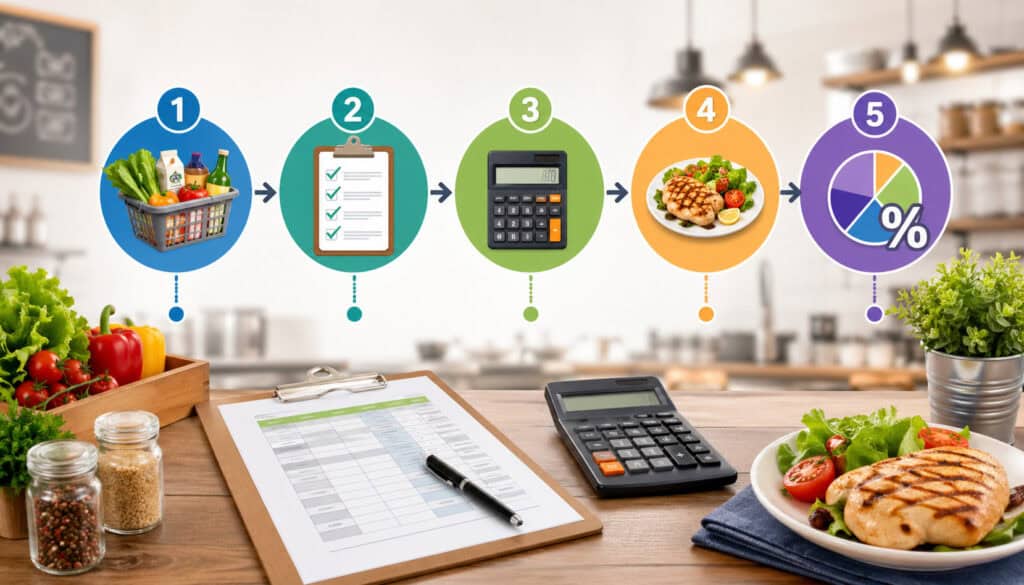
To Calculate Food Cost Percentage accurately, follow a consistent process. The formula is simple, but the accuracy depends on clean data and repeatable habits.
Start by choosing the reporting period. Many food service businesses calculate food cost weekly for operational control and monthly for financial reporting. Catering businesses may also calculate food cost by event.
Next, count the beginning inventory. This should be the value of all food items on hand at the start of the period. Then add purchases received during that same period. Make sure credits, returns, and supplier adjustments are included correctly.
After that, count the ending inventory. This should be the value of food still on hand at the end of the period. Subtract ending inventory from beginning inventory plus purchases to calculate cost of food sold.
Finally, divide the cost of food sold by food sales and multiply by 100.
Step-by-step process:
- Choose the reporting period.
- Count beginning inventory.
- Add food purchases.
- Subtract ending inventory.
- Calculate cost of food sold.
- Find food sales for the same period.
- Divide cost of food sold by food sales.
- Multiply by 100.
The most important rule is period matching. If inventory is counted weekly, use weekly purchases and weekly food sales. If inventory is counted monthly, use monthly purchases and monthly food sales.
Example Food Cost Calculation
Here is a realistic example.
Suppose a kitchen wants to calculate food cost percentage for the month.
- Beginning inventory: $12,000
- Food purchases: $28,000
- Ending inventory: $10,000
- Food sales: $90,000
First, calculate cost of food sold:
$12,000 + $28,000 − $10,000 = $30,000
Then calculate food cost percentage:
$30,000 ÷ $90,000 × 100 = 33.33%
In this example, the restaurant food cost percentage is 33.33%. That means 33.33% of food sales went toward food ingredients.
Now imagine ending inventory was counted incorrectly as $8,000 instead of $10,000. Cost of food sold would become $32,000, and the food cost percentage would rise to 35.56%. That one inventory error changes the result by more than two percentage points.
This is why accurate food cost calculation depends on reliable inventory counts, complete purchase records, and correct sales data.
How Often Should You Calculate Food Cost?
Food cost should be calculated often enough to catch problems before they become expensive. For many kitchens, weekly tracking is useful for operational control, while monthly tracking is useful for financial reporting.
Weekly food cost analysis helps managers identify sudden supplier price changes, waste spikes, ordering problems, and portioning issues. It is especially useful for high-volume kitchens, catering operations, multi-unit teams, and menus with volatile ingredient prices.
Monthly food cost reporting gives a broader view of profitability. It smooths out unusual weekly changes and helps compare performance across periods.
Menu-level and recipe-level tracking should happen whenever prices, portions, ingredients, or yields change. Recipe costing is especially important before launching a new item, changing suppliers, adjusting portion sizes, or updating menu pricing.
A practical rhythm may include:
- Weekly inventory checks for key products
- Weekly purchase and price review
- Monthly full food cost percentage calculation
- Recipe costing whenever ingredients or portions change
- Event-level costing for catering jobs
Food Cost Percentage vs Recipe Costing
Food cost percentage and recipe costing are related, but they are not the same thing.
Food cost percentage shows overall business performance during a reporting period. It tells you how much of total food sales was spent on food ingredients. This is useful for measuring broad food cost control, inventory accuracy, purchasing performance, and restaurant profitability.
Recipe costing looks at the cost of one menu item. It calculates the ingredient cost for a specific dish based on portion sizes, yields, trim loss, cooking loss, and current supplier prices. This helps determine whether an item is priced correctly.
For example, the overall food cost percentage may show that the kitchen is running at 32%. But recipe costing may reveal that one popular entrée is running at 45% while another item is running at 22%. Without recipe-level detail, the high-cost item may continue to hurt margins.
Recipe costing supports menu pricing because it shows the true cost of each dish. It helps chefs and managers understand whether a menu item can support the desired selling price, portion size, and profit margin.
Overall food cost percentage answers: “How is the business performing?”
Recipe costing answers: “How profitable is this menu item?”
Both are necessary for strong food cost management. A kitchen can have accurate recipe costs but poor overall food cost due to waste, theft, overproduction, or inaccurate inventory. Likewise, a reasonable overall food cost percentage can hide weak margins on specific items.
For catering teams, recipe and event costing are especially important because guest counts, service styles, and overproduction can change profitability quickly. This food cost tracking guide for catering businesses offers useful context for event-level variance, yield, and package pricing.
Common Mistakes in Food Cost Calculation
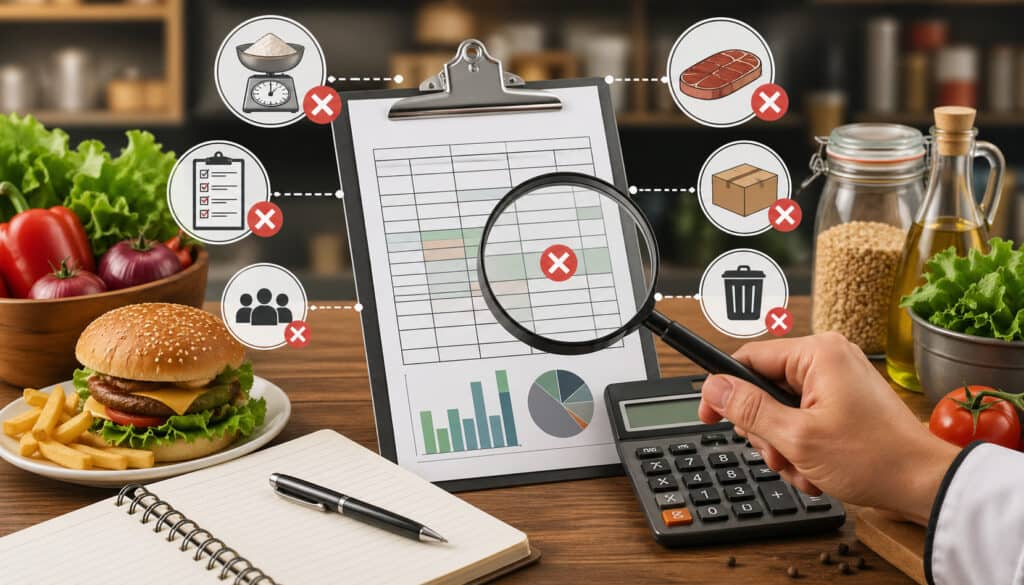
Food cost calculation errors are common because the process depends on many moving parts. Inventory, invoices, sales, waste, recipes, units, and supplier pricing must all be accurate.
One of the biggest mistakes is using purchases as food cost. Purchases show what came into the business, not what was used. Without beginning and ending inventory, you cannot calculate cost of food sold accurately.
Another mistake is inconsistent inventory counting. If one manager counts unopened cases and another estimates partial containers, the results will vary. If prep items are counted one month but ignored the next, the food cost percentage becomes unreliable.
Missing invoices are another common issue. If an invoice is not entered, food cost appears lower than reality. Duplicate invoices create the opposite problem.
Other common mistakes include:
- Using total sales instead of food sales
- Ignoring waste, spoilage, and overproduction
- Not tracking staff meals or comps
- Mixing food and beverage costs
- Using outdated supplier prices
- Failing to update recipe costs
- Counting inventory in inconsistent units
- Not accounting for transfers between locations
- Ignoring yield loss from trimming or cooking
- Using estimates instead of actual counts
Inconsistent units can cause major problems. If an invoice lists tomatoes by case, recipes use ounces, and inventory counts use pounds, the calculation must convert units correctly.
Waste is another blind spot. Spoiled products, burnt batches, incorrect orders, and over-prepped ingredients all affect food cost control. If waste is not tracked, managers may blame pricing when the real issue is production planning.
How to Improve Food Cost Control
Improving food cost control requires more than calculating a percentage. The real value comes from using the number to guide better kitchen decisions.
Start with portion control. Even small over-portions can create major cost increases when multiplied across hundreds or thousands of plates. Standard scoops, scales, ladles, prep charts, and plating guides help keep portions consistent.
Next, review menu engineering. Some items may sell well but produce weak margins. Others may have strong margins but low visibility on the menu. Food cost analysis helps identify which items to promote, reprice, resize, reposition, or remove.
Supplier comparison also matters. Ingredient prices change, and a once-competitive vendor may no longer be the best option. Regular supplier reviews help protect margins, but quality, consistency, delivery reliability, and yield should also be considered.
Food cost control also depends on strong kitchen inventory management. FIFO rotation, par levels, waste logs, receiving checks, and regular inventory reviews help reduce spoilage and over-ordering.
Practical ways to improve food cost control include:
- Standardize recipes
- Train staff on portioning
- Use prep sheets based on forecasted sales
- Track waste daily
- Review supplier prices regularly
- Count inventory consistently
- Set par levels for key items
- Compare actual cost to theoretical cost
- Reprice menu items when ingredient costs change
- Review low-margin, high-volume menu items
Track Waste and Spoilage
Waste tracking is one of the most practical ways to improve food cost management. A waste log shows what is being discarded, why it was discarded, and how much value was lost.
Waste can come from many sources: overproduction, poor rotation, prep mistakes, cooking errors, expired ingredients, incorrect orders, returned dishes, and inaccurate forecasting. Without a waste log, these issues often stay hidden.
A useful waste log should record:
- Date
- Item wasted
- Quantity
- Estimated cost
- Reason for waste
- Staff member or station
- Corrective action
For example, if the same sauce is discarded every week, the prep batch may be too large. If they produce spoils before use, ordering levels may be too high. If proteins are wasted during prep, staff may need yield training.
Waste tracking turns food cost control into a daily habit instead of a month-end surprise.
Standardize Portions and Recipes
Standard recipes protect margins and improve consistency. They tell staff exactly what ingredients to use, how much to use, how to prepare the item, and how the finished dish should be served.
Without standardized recipes, two cooks may prepare the same menu item differently. One may use more cheese, extra sauce, a larger protein portion, or a different garnish. These small differences affect both guest experience and food cost percentage.
Standard recipes should include:
- Ingredient names
- Exact quantities
- Unit conversions
- Yield information
- Prep instructions
- Portion size
- Plating standards
- Current ingredient costs
Recipe costing should be updated whenever supplier prices, portion sizes, ingredients, or yields change. This keeps menu pricing aligned with real costs.
Review Supplier Pricing Regularly
Supplier pricing changes often, especially for proteins, dairy, produce, oils, grains, and specialty items. If recipe costing is based on old prices, menu margins may be inaccurate.
Regular supplier reviews help managers understand price movement and decide whether to adjust menu prices, change portions, negotiate with vendors, substitute ingredients, or promote different menu items.
Supplier review should not focus only on the lowest price. A cheaper product may have lower yield, shorter shelf life, inconsistent quality, or higher prep waste. True cost includes usable yield and operational impact.
For example, a lower-priced case of produce may not be cheaper if more of it is trimmed, spoiled, or rejected. A higher-quality product with better yield may produce a lower actual recipe cost.
Using Inventory Software for Accurate Food Cost Calculation
Manual spreadsheets can work for small operations, but they become harder to manage as menus, suppliers, recipes, and locations grow. Inventory software can improve accurate food cost calculation by reducing manual entry, standardizing counts, and connecting purchases, recipes, inventory, and sales data.
Digital inventory tools can help teams track:
- Beginning and ending inventory
- Supplier purchases
- Invoice prices
- Recipe costs
- Menu item margins
- Waste and spoilage
- Inventory transfers
- Par levels
- Purchase trends
- Food cost reports
- Actual vs theoretical food cost
Software is especially useful when teams need consistent inventory cost tracking across multiple users or locations. Instead of relying on scattered spreadsheets, managers can use one system for counts, costs, recipes, and reporting.
Some platforms also connect POS data with inventory. This makes food cost analysis more accurate because sales activity can be compared with expected ingredient usage. For additional context, this guide on linking POS data with inventory for real-time cost tracking explains how POS and inventory data can support better cost visibility.
Inventory software also helps with recipe costing. Once ingredient costs and recipe quantities are entered, the system can calculate menu item costs and update them when supplier prices change.
However, software does not replace good processes. Staff still need to count inventory correctly, receive deliveries carefully, enter waste honestly, and maintain recipes accurately. The system improves visibility, but the data must still be reliable.
For teams building stronger stock control habits, this resource on setting up kitchen inventory management can be useful.
What Is a Good Food Cost Percentage?
There is no single food cost percentage that works for every food service business. The right percentage depends on concept, menu style, service model, ingredient costs, pricing strategy, labor structure, portion size, waste levels, and business goals.
A fine dining operation may accept a different food cost percentage than a quick-service kitchen. A steakhouse, bakery, café, catering company, hotel kitchen, and ghost kitchen may all have different target ranges because their menus and operating models are different.
A higher food cost percentage is not always bad. Some items have high ingredient costs but strong selling prices and excellent contribution margin. A lower food cost percentage is not always good either. If portions are too small, quality is weak, or guests stop ordering, profitability may suffer.
The better question is: “Does this food cost percentage support the desired margin, guest experience, and business model?”
To set a useful target, consider:
- Menu category
- Ingredient volatility
- Portion expectations
- Selling price
- Labor requirements
- Waste risk
- Competitive positioning
- Guest value perception
- Contribution margin
- Sales volume
For example, a premium entrée may have a higher food cost percentage but still generate strong cash profit per plate. A low-cost side item may have a low food cost percentage but contribute less total profit.
Food cost percentage should be reviewed alongside menu engineering. Operators should evaluate popularity and profitability together, not in isolation.
FAQs
How do you calculate food cost percentage?
To calculate food cost percentage, divide cost of food sold by food sales and multiply by 100. Cost of food sold is calculated by adding beginning inventory and purchases, then subtracting ending inventory.
What is the food cost percentage formula?
The food cost percentage formula is: Food Cost Percentage = Cost of Food Sold ÷ Food Sales × 100. The cost of food sold formula is: Beginning Inventory + Purchases − Ending Inventory.
What is cost of food sold?
Cost of food sold is the value of food inventory used during a specific period. It is not the same as purchases because some purchased inventory may still be unused at the end of the period.
How often should restaurants calculate food cost?
Many food service businesses calculate food cost monthly for financial reporting and weekly for operational control. Recipe costs should also be updated whenever supplier prices, portions, ingredients, or menu prices change.
What causes high food cost percentage?
High food cost percentage can be caused by over-portioning, waste, spoilage, theft, outdated menu prices, supplier price increases, inaccurate inventory counts, missing invoices, or recipes that are not costed correctly.
How can food cost percentage be reduced?
Food cost percentage can be reduced by improving portion control, tracking waste, reviewing supplier prices, updating menu pricing, standardizing recipes, using FIFO rotation, setting par levels, and training staff.
Is food cost percentage the same as recipe cost?
No. Food cost percentage measures overall food cost compared with food sales for a reporting period. Recipe cost measures the ingredient cost of a specific menu item.
Can inventory software help calculate food cost?
Yes. Inventory software can help track purchases, inventory counts, recipe costs, supplier prices, waste, and food cost trends more accurately than manual spreadsheets.
Conclusion
To Calculate Food Cost Percentage accurately, food service teams need more than a formula. They need reliable inventory counts, complete purchase records, correct food sales data, waste tracking, recipe consistency, supplier price updates, and regular reporting.
The core formula is simple: cost of food sold divided by food sales, multiplied by 100. But the quality of the result depends on the quality of the data behind it.
Accurate food cost calculation helps operators price menus correctly, protect margins, reduce waste, improve kitchen inventory management, control portions, and make smarter purchasing decisions. When food cost management becomes a regular operating habit, teams gain better visibility into profitability and can respond before small issues become major losses.